Feeds:
Posts
Comments

Posts Tagged ‘story’

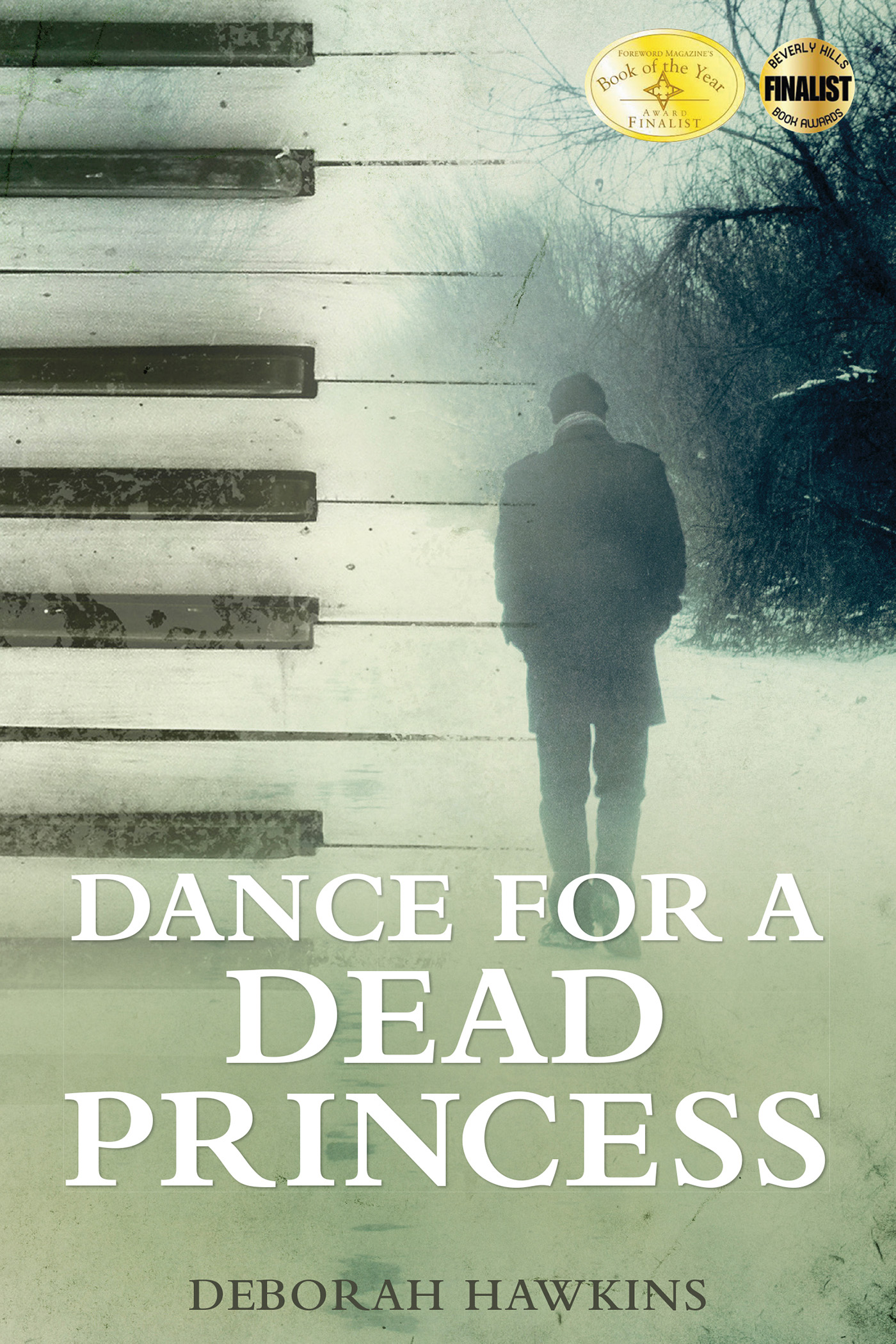
This week I managed (finally) to figure out how to post the cover of my novel on my blog. See, there it is on the sidebar. Now don’t laugh. Sometimes I think writing and editing it was easier than finding out how to use that pesky little image widget. (Just kidding.) And then there was the problem of how to post links to Amazon and Barnes and Noble. I googled and goolged and googled before I got that right. And I’m not sure those links are all pro, but they work. That’s all that counts.

I decided to publish Dance for a Dead Princess myself for several reasons. One, the whole business of finding a literary agent seems to have changed radically. Back in 1995 when I found the lovely lady who represented Summer’s Child, the whole process of agent rejection was more like a stately dance. I sent my book summary and sample chapters off in discreet navy folders, and they came back in my prepaid envelopes with “No Thanks” scrawled on the cover page. Moral of story: a human opened and at least looked a them. Until by and by, a human liked them and represented them.

Summer’s Child came close but did not sell, and another author appropriated my title (without asking me, but never mind), and my agent retired while I built a law practice and raised my children. (No small feat, by the way.) Then, a year or so ago, when I dove into the Literary Agent Ocean once more because I now had two novels I wanted to publish, I was shocked at how things had changed. Just their websites were hostile and uninviting. “Closed to submissions.” “We do not consider unpublished writers.” “We only accept referrals.” Couldn’t they have just written it out, “We are just TOO GRAND to ever read a WORD you’ve written even if it’s only a Cover Letter”? Or “If you’ve NEVER BEEN PUBLISHED we do not consider you LITERATE no matter how many GRADUATE DEGREES you have.” And then, the ones who had a tiny chink in their website armor allowed email submissions to which they promised NEVER TO REPLY. (But logical question: at some point weren’t all now published authors unpublished and didn’t they turn out to be both LITERATE and ENTERTAINING? Doesn’t that sort of squash the Literary Agent view of the Unpublished? Just a thought.)

Now, I am a lawyer, and law is not a profession known for being touchy feely. But I at least tell people when I am not going to represent them. And I do so in very polite lawyerspeak on ivory twenty-pound bond, personally signed by me, which they can cherish for a lifetime along with my highly impressive letterhead. (Don’t laugh. If you are a lawyer, you are selling your brain, so your letterhead has to be IMPRESSIVE to convince the client your brain is worth the fee.) “Dear Ms. XYZ, having considered the facts of your case, I have concluded I am not the right attorney for your file. Best of luck with your matter. Very truly yours, etc.”

Now, I hasten to add, one or two agents wrote me polite and professional turndown letters; and I respected their sincerity. In particular, they acknowledged what a feat it is even to create a novel even if mine was not right for them. But they were the minority, and I just didn’t see the point of beating my head against the closed Literary Agent Door. It reminded me of trying to get into social clubs in high school. The Cool Kids were never going to let you in no matter your merits because they had deemed you unworthy without ever taking time to even talk to you.

Anyway, Literary Agents were a barrier to entering the world of author. But they were no longer insurmountable. And even more importantly, I had seen what traditionally published authors go through. Back in the day, before I found My Agent, a published friend of mine shared her tribulations as her then-agent tried to turn her into Olivia Goldsmith (who was hot at the time; she died during plastic surgery. No comment.) My friend did not want to write the Big Hollywood genre thrillers the agent wanted. So her next move was to Agent Two, who, so far as I know, let her be herself. But I noticed that when her publisher published her books, she had to do all the work of promoting it. And I don’t mean being flown around first class from New York, to Boston, to London, and Paris with appearances on the Today show and GMA. No, my friend had to call the local bookstores, beg for book signing dates, haul her books there, and hope someone would show up to see her and ask her to sign one. In short, she was doing all the work, and it was not glamorous.

Now, I gave up big law firm practice to work for myself. There are upsides and downsides, of course, to that decision but I am my own boss. (And I’m pretty nice to work for, by the way.) So it made sense that if I was going to be a writer (and I’ve been a storyteller since the day I was born and a writer since age 11), I would light out for the Territory on my own. Hence decision: self-publish.

On March 30, 2013, I uploaded Dance For A Dead Princess to Amazon, Barnes and Noble, and Smashwords, armed only with my favorable Kirkus review and determined to figure out how to tell the world about my book. A great read. Cheaper than a Starbuck’s latte and lasts longer too. In the past month, I have floundered as I learned the ways of promoting a book. Some sites are very straightforward: send us money. Ok, I can handle that. Some sites have RULES that are as complicated as magic spells (and which makes me wonder if it would be easier to order a spell from California Psychics). The RULES go like this: You must have x stars, x reviews no longer than x which were not created under a New or Full Moon. Wow, mind boggling. Worse than the California Rules of Court. (Trust me, those babies are better than sleeping pills!) Of course, my question for those sites – pardon me for being lawyerlike – is how do you get x reviews with x stars under whatever moons your prescribe until you can let the word know your book is out there? Isn’t publicity designed to inform readers you and your book exist so they can create the x reviews, with the x stars under the required moons? Or am I being too logical?

Anyway, my novel and I have emerged into the new world of Novel Promotion where right now I feel as if I’m standing under a dark sky watching all the tiny little stars of all the books in the world shine down at me. But I believe in Dance or I wouldn’t have come this far. So I’ve just got to figure out how to help it shine a little brighter so readers who would love it will find it. This is a new journey, and I’m up for it.

dance-dead-princess-728x90[4] (1)

Kirkus Reviews

Read Full Post »

Jimmy Carter left the Southern Baptist Conference after more than sixty years. He had been a deacon and a Sunday School teacher, and he is a profoundly and sincerely religious man. But his reason for leaving the Southern Baptists: the church’s increasing rigidity over the equality of women. Relying on certain passages of scripture, the Southern Baptists insist upon a wife’s subjugation to her husband. And they no longer allow women in the ministry.

Southern Baptists are the United States’ largest Protestant denomination, with 15.9 million members. I doubt that people who have not lived in the South understand what a powerful presence they are in Southern society and culture. My own grandfather was a rigid Southern Baptist who believed in eternal damnation for setting foot in any other church. As a child, I was bundled off to Sunday School and kindergarten at the Southern Baptist church that literally sat on our doorstep. (Eventually they would buy the house I grew up in and turn it into a parking lot, an act of destruction that has always left me profoundly sad.)

I was lucky that my early contact with the mighty Southern Baptist conference had nothing to do with doctrine and everything to do with my parents not wanting to go to church themselves. They shuffled me across the street, Sunday after Sunday, and then went home to put their feet up, read the paper, and drink coffee until it was time to pick me up. The perfect example of “Do as I say, not as I do.”

Eventually, though, being Southern parents, mine were forced to decide about their children’s Religious Affiliation. Southerners have to have some sort of Religious Affiliation to use on Easter and Christmas. And to get married and buried.

Since I had not been baptized as an infant – a practice my Southern Baptist father would never have agreed to and my Methodist mother had no opinion about – I necessarily would have to be baptized as a pre-teen or teen. But the point was, I was a daughter of the South and so I had to be baptized somehow, to avoid going to hell, of course. (Hell at that point was thought to be populated by Northerners, at least unreconstructed Southerners thought so. I didn’t give it much thought since I never planned to wind up there. And it did seem to me that the Civil War had been over for quite some time.)

My parents eventually lit upon a sect of Presbyterians who conducted services as if they were Episcopalians minus kneeling, the sign of the cross, and robes on the minister. For some reason, these Presbys were taken with the beauty of the Anglican liturgy (me, too, by the way) and they adopted it as their own. My father quit being a Southern Baptist and my mother quit being a Methodist, and I got baptized and turned into a Presbyterian by having a red carnation dipped into a bowl of water and squashed on top of my head. Whew! Eternal Damnation avoided! (I fully believe God has a sense of humor because He gave me one.)

By and by, to the absolute horror of my parents, I became an Episcopalian. This required yet another baptism for technical Episcopalian reasons. In their world, water on top of the head doesn’t save you. It has to cross your forehead. So to make absolutely sure I was good and baptized for all time, the priest poured water from a silver shell over my forehead. Killed the hairdo, but now Nothing stood between me, Saint Peter, and those Pearly Gates.

At first, I wanted to be an Episcopalian so that I could walk into any Anglican communion anywhere and hear the beautiful words of the liturgy. I loved that feeling of community when the priest intoned that gorgeous subjunctive phase, “The Lord be with you.” And we answered, “And also with you.” If I went to a Presbyterian church, other than the one I grew up in, I would not hear the liturgy. Then, by and by, my first child turned out to be a daughter. And I wanted her to grow up in a church where women could be priests if they wanted to be. I couldn’t see the point of a religion that told women from the get-go, you’re not good enough.

I have admired Mr. Carter always. He is a man of integrity in a world where integrity is in short supply. And I know what a hard decision he had to make. A Southern Baptist heritage is like being bound by tentacles.

For me, I chose well. You can be anything, anyone, anybody and be an Episcopalian. We have women priests, men priests, gay priests, lesbian priests, and yes, married priests, hetero and gay. Oh, and Bishops, too, come in all varieties. We are the ones the Catholics come to when divorce makes them ineligible to be Catholics anymore. We don’t have to stand on street corners and preach (Southern Baptists did this when I was growing up) and we don’t condemn anyone else’s religion. We are pretty sure God doesn’t either. And we are absolutely sure that women are equal in this world and the next. Back in the day, the Baptist Sunday School taught me to sing this song, which doesn’t say anything about having to be a male child to gain the All Access Pass to Heaven.

Jesus loves the little children
All the children of the world
Black and yellow, red and white
They’re all precious in His sight
Jesus loves the little children of the world.

Love Comes in All Shapes and Colors

Love Comes in All Shapes and Colors

Read Full Post »

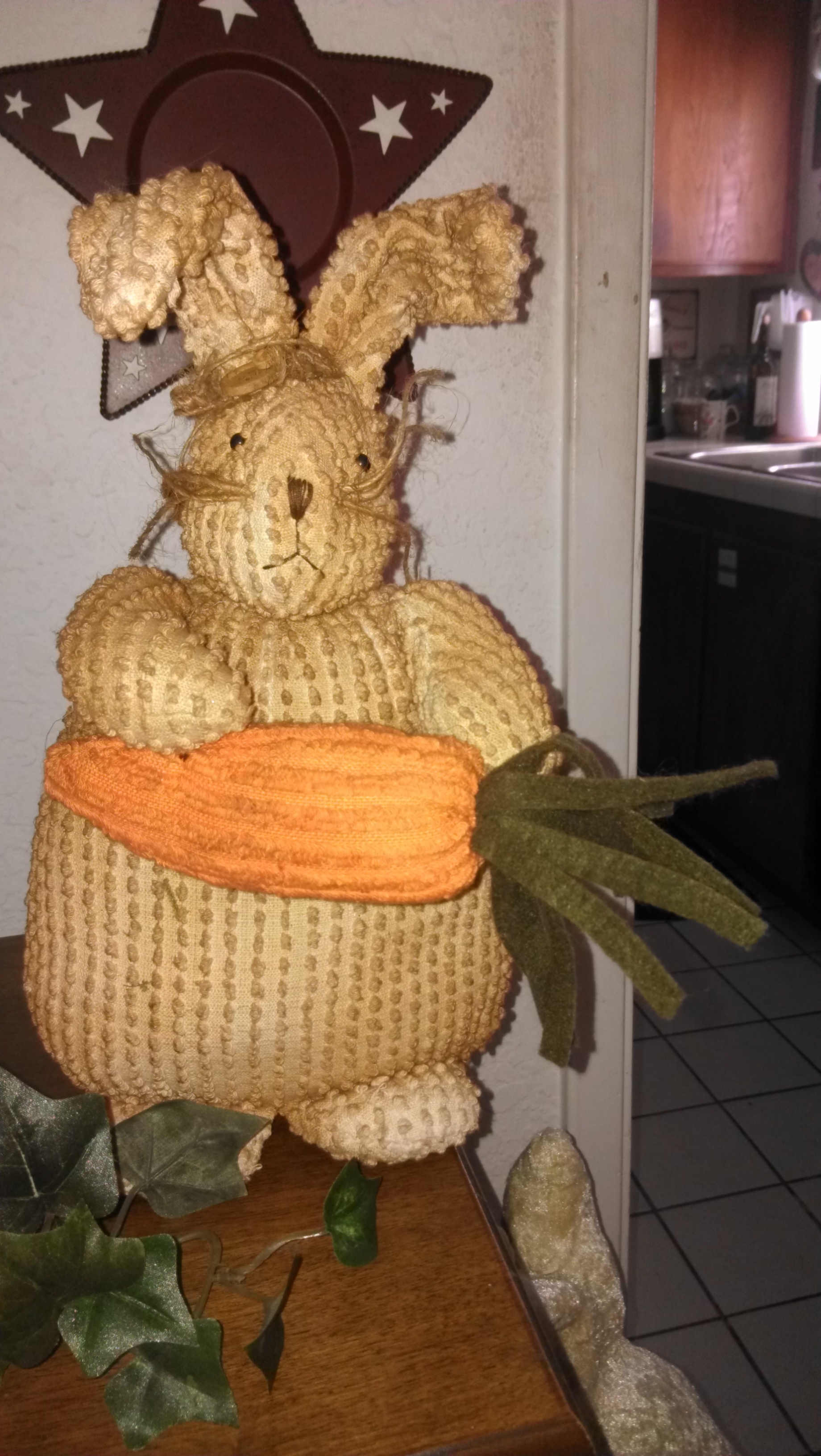
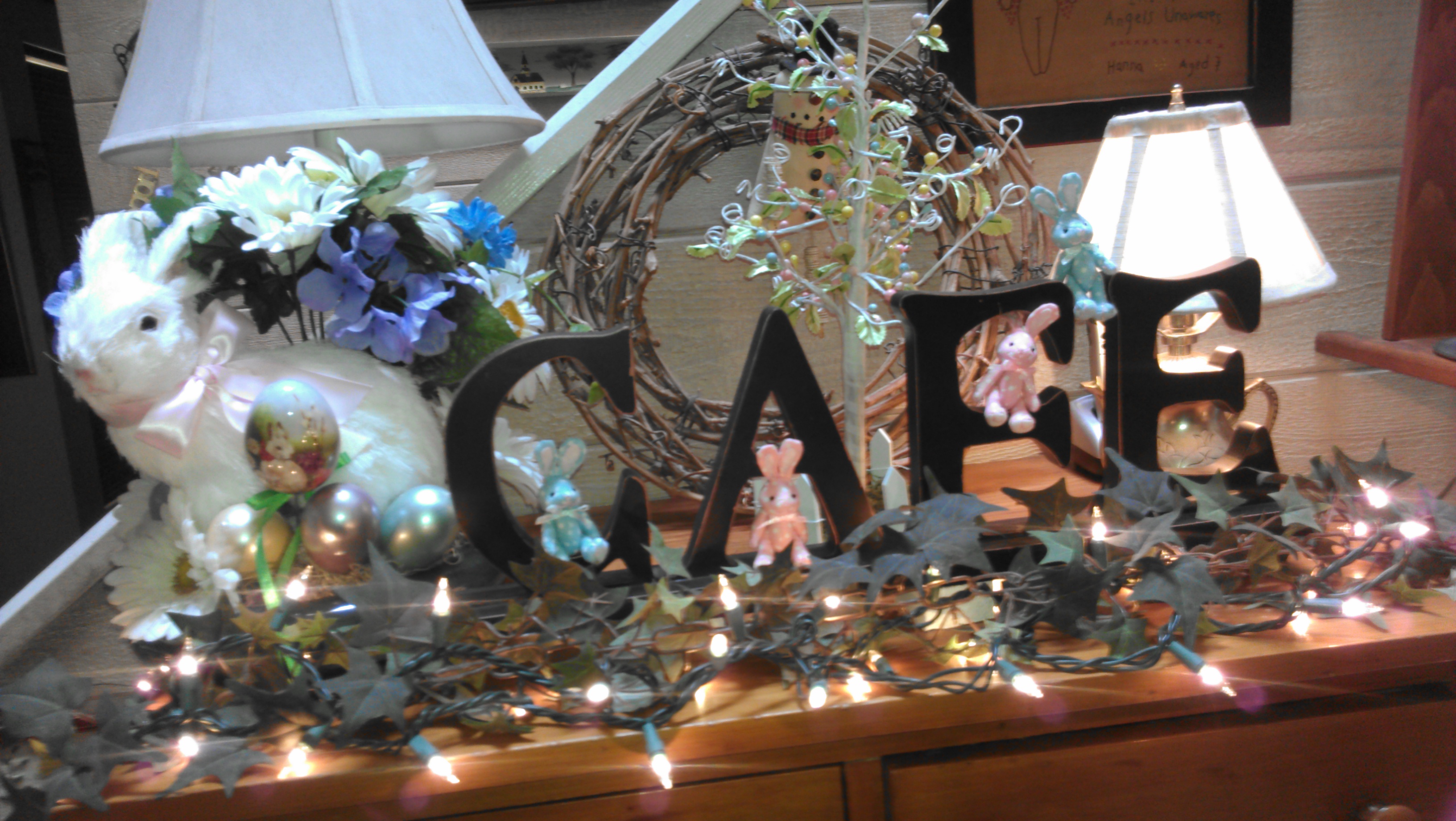
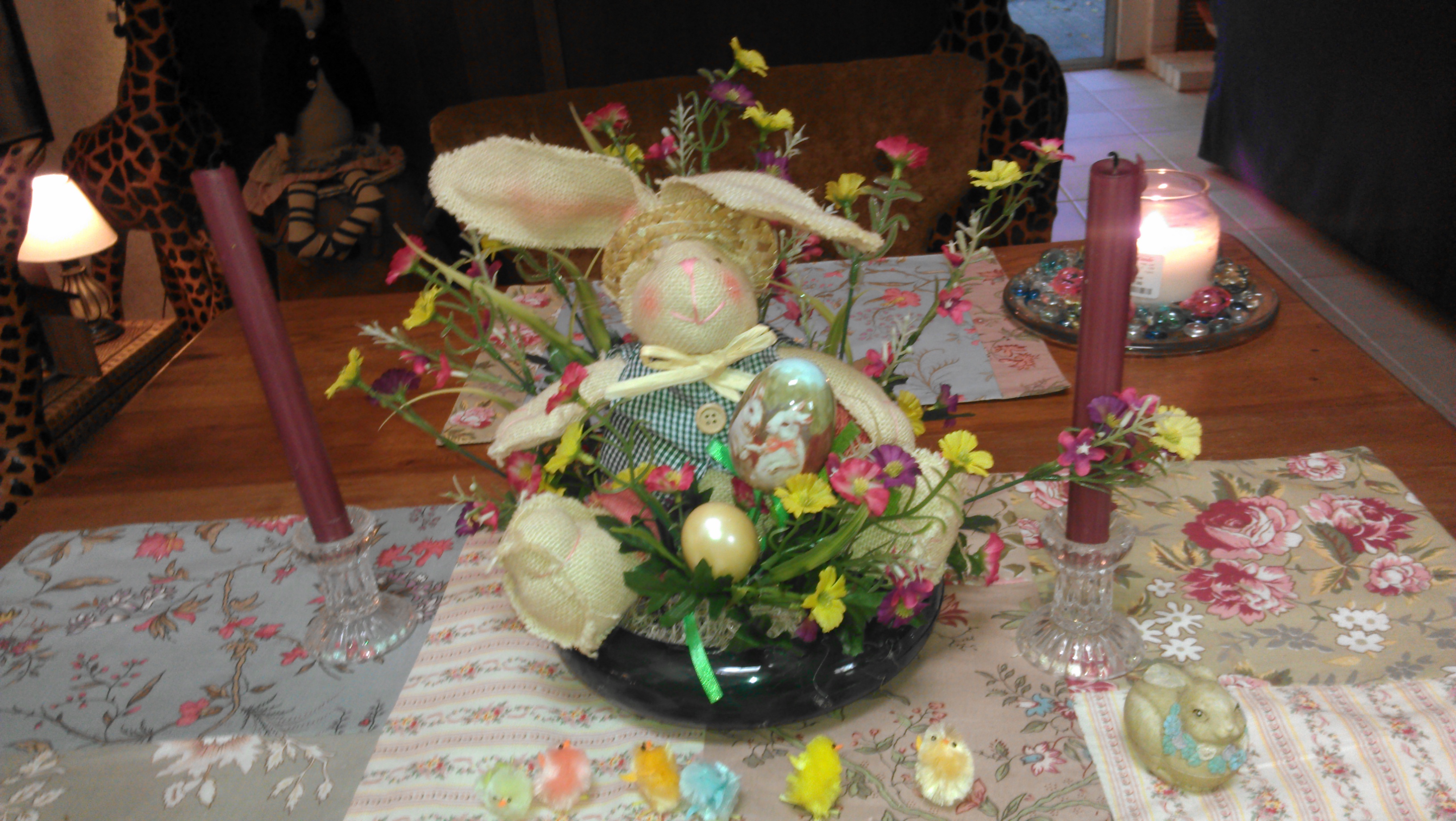
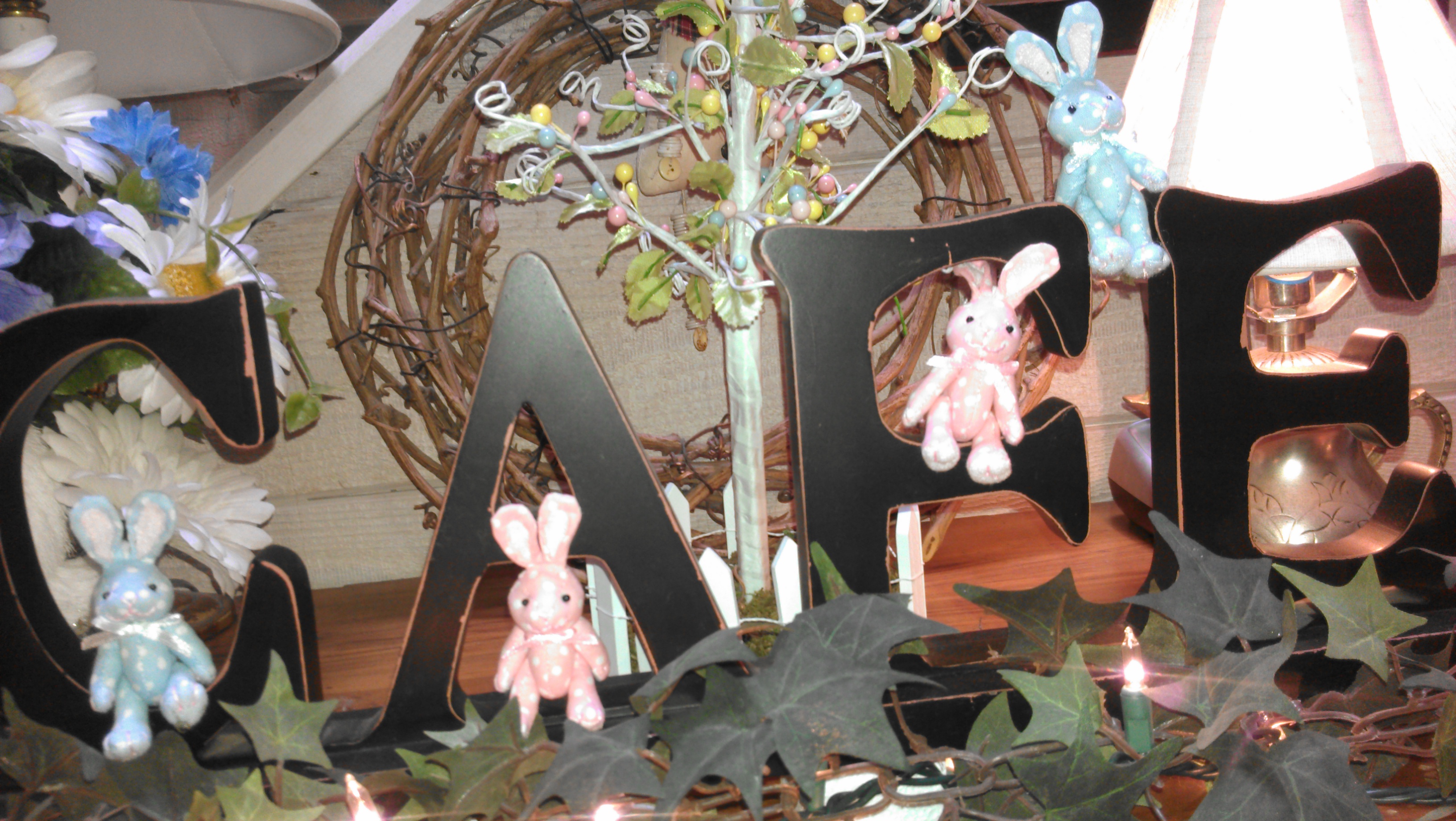
The Easter Bunnies eyed me from the front door this morning and said they are not ready to come down. Normally on the first of April I would be putting them up, not taking them down. The green shamrock wreaths always rule the month of March. But the calender played a trick this year and stuck Easter on the day before April Fool’s, leaving me with some unhappy leprechauns who didn’t get to come out of their boxes in March.

In my last post, I explained how my neighbor Lenore inspired my monthly door decorating sessions. Her whimsical greenhouse window displays reminded me that each month has something special to celebrate. I also was inspired by my southern roots, particularly the years I lived in Virginia where I first noticed wreaths displayed on doors year round.

California entrance doors don’t seem to need decorations (except at Christmas) because front doors aren’t used. Most Californians enter their homes through the garage. They pull up in their expensive European sedans, hit the garage door opener hidden in the car’s sun visor, and vanish into the depths never to be seen again. Or at least, never to be seen until the next time the garage door goes up, and they pull out once again in their expensive European sedans. (At Four-Way Stop Intersections in California, the first car to go is not the first one that stopped; it’s the most expensive. Heaven help the Mercedes driver who encounters a Lamborghini.)

When I first came to California in the mid 1980’s, I noticed that the houses here don’t look out on the street the way houses do back east. Where I grew up, and throughout the South, houses have front windows that seem to look outward like eyes. And backyards don’t have fences; or if they do, they have the chainlink ones that let you see into the yard next door. But in California, houses more often look inward toward a pool or courtyard. And people here put high wooden fences around their yards, so you know you have a neighbor, but you cannot see hide nor hair of him or her. I came to wonder if this modern-day residential phenomenon could be attributed to the history of California because people from back east arrived to live on isolated ranches and to fend for themselves. When they urbanized, they continued to keep their neighbors out of sight as much as possible.

At any rate, I am a cultural anomaly here because I both use and decorate my front doors. (Yes, I have not one, but two. And I saved them from the vicious Homeowner’s Association over a a year ago and vanquished a male chauvinist bully on Yelp while I was at it. But that is yet another story.)

To keep the peace, I promised the bunnies they could stay until Saturday. Then they have to go back to their boxes until next year.

Can't It Stay Easter for a While?

Can’t It Stay Easter for a While?

Cheeky Bunnies

Cheeky Bunnies

I refuse to leave:  squatter's rights.

I refuse to leave: squatter’s rights.

Cheeky Bunnies Demanded Their Close-Up

Cheeky Bunnies Demanded Their Close-Up

Read Full Post »

Last week, on the day before Valentine’s Day, my son called home from college.

“Mom, I need the fudge recipe.”

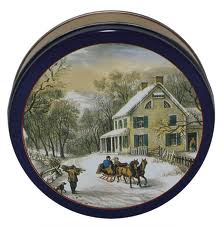
Now here was a bit of family lore that had drifted silently into dry dock, and I’m not quite sure if I can say when. Back in the day when all three kids were home and fairly small, fudge at Christmas was our special family treat. Even in the years when Christmas had to be celebrated on a shoestring, fudge was always affordable. It was our go-to gift for their friends, for their teachers at school, for their music teachers, and for anyone else who happened to cross our paths at the holiday. And it was blissfully appropriate across all religious lines as long as I remembered to buy only “Happy Holidays” tins at Walmart. (None of the kids’ friends had a problem with the ones with Santa Claus on top, either.)

Now, candy was an interesting subject at our house. I do not know if modern Southern mothers raise children who are forbidden to have candy, but I was not raised that way, and it never occurred to me to banish candy. Perhaps because it was so available, my children were never particularly interested in it. The miniature candy bars in the toes of the Christmas stockings became petrified wood by the time I remembered to throw them out at Easter. Similarly, the pastel foil wrapped chocolate eggs thoughtfully provided by the Easter Bunny languished into melt down as summer approached. And my children would politely nibble an ear off a chocolate rabbit and then wrap it up forever more. At Halloween, they counted their loot and put it away until Christmas. It is amazing that we didn’t have more ants in the house more often.

So because candy was never forbidden, it never made anyone’s heart beat faster. On the other hand, when the children who were being raised Sugarless came over, I’d find the little jars of Hershey’s kisses on the kitchen counter empty by the time they went home. Which was fine. The kisses were there to be eaten, and we probably weren’t going to eat them. And I would never inform the Sugar Police on our little visitors.

But fudge at Christmas was a different story. Maybe because fudge is creamy, gooey chocolate like none other and maybe because it appeared but once a year, every fudge crumb ever concocted on our stove was consumed.

When Michael called last week, I panicked. Where was the recipe? I had once known it by heart, and for a full ten minutes I could not even think where the written version was. Losing it would be like losing the baby teeth the Tooth Fairy had taken out from under their pillows and hidden in my jewelry box. Some parts of family lore are just too precious to lose.

“I’ll have to hunt for it and call you back,” I told him. (Southerner’s “hunt” for things; we do not “look for” them.) As soon as I got off the phone, I sat quietly and tried to think it through. I had no idea where the written version was because I had made it so many years by memory. Yet I knew it was written down. I am careful to keep important things like that written down.

I closed my eyes and thought about how ordinary things are no longer ordinary when they are woven into the fabric of a family’s life. There are the special ornaments that have to be on the Christmas tree each year. There is the Thanksgiving stuffing that must contain sausage and oysters, but no mushrooms. There is the one and only birthday cake with chocolate butter cream to paste the layers together, and vanilla butter cream on the outside. There are the Easter Bunny footprints stealthily stenciled on the front walk at midnight with flour. There was our first dog’s birthday on July 4, and now our current dogs’ birthdays on February 2 and March 3. These things and these dates and these memories are sewn together to make the quilt of our unique family story. And each is important and never to be lost or forgotten.

So where, oh where was the fudge recipe? Of course, in the binder of family recipes that I had put together over the years. Within fifteen minutes, I had typed it into an e-mail, and it was on its way to my son who called shortly thereafter.

“Thanks, Mom.”

“No problem. Glad you reminded me where it was.”

“Well, I’m being cheap. Instead of buying chocolate, I’m making it for her.”

“Oh, no. That’s not cheap. Any gift from your own hands, of your own time, is never cheap. You guys have a very Happy Valentine’s Day!”

And so a bit of our family lore was recovered, renewed, and passed on.

Holiday Tin

Holiday Tin

The Good Stuff

The Good Stufff

Read Full Post »

Two years ago, I started “The Smile Project” because I became uncomfortable with “The Zombie Zone.” I realized that when I passed a person I did not know – in a parking lot, in a grocery store, at the gym, or while waiting in line to use the Ladies’ Room (because ladies, unlike gents, ALWAYS have to wait in line) – the two of us entered a Dead Zone where we were close enough to greet each other or at least acknowledge each other. But, of course, we didn’t do that because we were strangers. No, we passed with blank, dead looks on our faces. In other words, we became Zombies passing in the night. (Or in the day as the case might be.)

I didn’t like the Zombie Zone. I hated that split second when the approaching stranger was close enough to require turning my head to avoid eye contact. If I timed it wrong, and our eyes met, we became two strangers awkwardly wondering what to say to each other. If I timed it right and got my eyes out of there in time, we became two strangers awkwardly avoiding each other. None of this felt good to me.

I considered what to do. Throwing out a “Hi” seemed like a bad idea. The trouble with speaking was I’d be overheard, and I’d look and feel like a Real Idiot if I didn’t get a return greeting. And the odds were pretty high in California that random strangers were not going to greet me back.

So I decided to found “The Smile Project.” The rules were I had to smile at every stranger, young or old, male or female, who came within the Dead Zone. I’d wait until that moment when eye contact should be avoided, make contact, and smile. And then I would wait to see what happened. It was a no risk proposition because if my smile didn’t Undead the approaching Zombie stranger, no one but me would know.

I have enjoyed watching the reactions to “The Smile Project.” There are, of course, the Zombies who remain Undead and ignore me. (“Really, why is that strange woman smiling at me? Do you think she wants something? She’s kind of cute, but I don’t know her. Better get out of here fast where no one is smiling at me.”)

But most of the time, the reaction to my smile is a return smile. There is usually a startled moment in the beginning while my target tries to figure out why this strange woman is smiling at him or her, followed by a (1) a tentative return smile or (2) a big grin. Once in a while, my target will smile and say Hi, or Nice Day or even wave. A smile is the greatest icebreaker in the world.

The Smile Project is also very useful when Waiting in Line. Californians do not Wait in Line well. They whine, complain, and look for ways to cut. They do not simply settle in and accept the inevitable truth: there are other people on the planet and They are Ahead In Line. So here’s where The Smile Project comes in handy. I scope out my fellow Line Mates and smile at the one (or even two) who don’t break eye contact the minute they see me. I smile and say, “Nice earrings,” or “I love your boots,” or “Yeah, we love pepperoni pizza at our house, too.” Usually from my minimal effort, a conversation is born that makes me, at least, forget about having to wait. Other people love to tell their stories. And since I am a storyteller, I have two great passions: telling stories and listening to them. So passing the time listening to someone’s story is well worth the price of a smile.

The Smile Project is also like garlic to vampires when it comes to warding off angry stares. The grocery stores here have aisles wide enough for one and a half carts. That means if you stop your cart to select an item, you are automatically blocking traffic. And every turn from one aisle to the next is a blind turn because of the stuff they pile at the end of the aisles. Pulling your cart out in front of another person or asking someone to let you pass by can net you an angry glare because that person has just been forced to recognize There Are Other People In the World; and right now, in particular, Those Other People are in Their Own Personal grocery store. However, throwing out a random smile usually gets me a smile in return and often a pleasant verbal exchange about the need for smaller carts or wider aisles. You can see a glare melt under the shine from a smile. You really can.

The Smile Project is also a godsend in Costco where I am absolutely the Only Human Pushing a Shopping Cart and Watching Where I am Going. Haven’t you noticed that everyone in Costco is pushing his or her cart with his or her head sideways (think The Exorcist) looking for free food? Just smile when they run into you.

I invite you to try The Smile Project for yourself. It is totally no cost and very low risk. The worst that can happen is you will encounter a Zombie who likes being Undead. But not always. And something really magical happens when the Dead Zone vanishes because your smile has made a stranger’s eyes go from blank to warm. I didn’t expect much when I started The Smile Project, but it has been more than worth the effort.

Founder of the Smile Project

Founder of The Smile Project

Read Full Post »

I have been crying since mid-day on Friday. I came home after brunch with my oldest child, my lovely now grown-up daughter, to hear the horrible news from Newtown, Connecticut. For the rest of the day, I sat at my computer writing an opening brief in another heartbreaking case – a father’s trial for the abuse of his six-week-old baby – and I cried as I worked. It was all I could do.

I kept thinking of Jeremiah 31:15: “Thus saith the LORD; A voice was heard in Ramah, lamentation, and bitter weeping; Rahel weeping for her children refused to be comforted for her children, because they were not.” So I thought of Passover and, then, later of Herod’s massacre as he searched for the Christ child. Matthew 2:18, writing of Herod, parallels Jeremiah: “A voice is heard in Ramah, weeping and great mourning, Rachel weeping for her children and refusing to be comforted, because they are no more.”
There is no grief deeper, I think, than the loss of a child. Jeremiah and Matthew capture that. A born Southerner turns to the King James Bible in times of great grief, even if he or she hasn’t been in a church for some time. It is our heritage and our culture. So the words haunted me.

As I worked and cried, I looked over at the Christmas tree in my living room. News like this never comes at an acceptable time. But it’s particularly hard at Christmas when children of six and seven still believe in Christmas Magic. When my own children were small, I taught Sunday School; and every Christmas, I taught them about the coming of the Christ Child and about the shepherds and the Magi, who traveled to witness the miracle of so much love entering our world. Children of six and seven can believe in the magic of Santa and the joy of Christ’s birth whole-heartedly in a way that we, as adults, can only marvel at. And bask in its glow.

The conundrum of human love is that it inevitably leads to loss. In what form, we cannot predict. But from the beginning of any loving relationship, we know there will be an inevitable end. Some people – and I have known my share of them – refuse to love so they cannot experience loss. To me that choice is the equivalent of refusing to live. For only by loving others can we be truly who we were born to be and be truly alive.

When my grandfather was 104 and still as sharp mentally as anyone could be, he said one day that he was not afraid of death. He said that to him, death was simply another part of life. I have lived from my beginning knowing that we are immortal spirits. I will not tell you how I know. That is too personal. But I know. And so I know that the twenty-six amazing souls from Newtown have been separated from us, but they have only been transformed, not lost. Still, the separation is a great grief. Yet as I watch and experience this profound sadness, I see how this unthinkable loss unites us, and I marvel at the strength and the good that comes from human beings in the face of great tragedy. The word that Emilie Parker’s father used in his moving speech about his lovely child is the touchstone for all of us: Compassion.

I cannot travel to Newtown and place flowers or candles or stuffed animals at the memorial. I cannot tell every parent how I how hold them in my heart, and the tears I have shed with them. But on Saturday, I did finally think of my own private way to create a memorial in to these amazing souls. And it goes like this:

I was buying food at Trader Joe’s. Our TJ’s is also next to a Chuckie Cheese, so on Saturdays the little food store is full of families who have completed the Chuckie Cheese adventure and are buying groceries before heading home. Tiny people are whizzing tiny shopping carts through a highly crowded environment and, at the same time, looking for the Trader Joe’s Monkey, hidden somewhere in the store. Finding the Monkey nets a child a sticker or sometimes a gold coin made of chocolate.

As I began trundling my own adult-sized shopping cart through the store, I dodged several pint-sized shoppers who were bent on finding the Monkey and definitely were not looking where they were going. And suddenly I realized that I was not all inconvenienced by having to look out for them. No, I was inspired by their joy and happiness, and by their confidence they would reap the prize at the end of the adventure. And I thought that if the new little angels from Newtown were powering those shopping carts, they would be excitedly on the same adventure. And I was happy at the thought.

If you let it, the joy and magic of being a child can still rub off on your adult self. My own personal memorial will be always to enjoy and give thanks when I am in the presence of the magic of children. I have to say, I have always believed in this. Kids and dogs come to me spontaneously – I guess because I never grew up. But I don’t say think you enough for being in the presence of so much joy. And from now on, I will. And I will remember Newtown and its children, whenever I do. Thank you for the magic of being a child and for letting those of us who have grown up be touched by your magic. We love you.

Read Full Post »

The National Institute of Neurological Disorders and Stroke says “nearly everyone” at some point experiences lower back pain. What an optimistic thought!

Well, I can say I am now a card-carrying “nearly everyone” because for a few months now, my lower back has been complaining about being Itself. When I ran out of physical therapy sessions, I trotted off to see the Spine Specialist to get some more.

Now, the Spine Specialist was not someone to be taken lightly. Like a college course, he had Prerequisites. After getting over the first hurdle and demonstrating I had insurance and could otherwise afford him, I had to get over the second requirement: get the offending lower back x-rayed. However, that was not a difficult chore. I showed up at the Imaging Center, put on one of those silly hospital gowns that no one can tie in the back, and stood in front of the x-ray machine, having a pleasant chat with the technicians for about ten minutes. Blood pressure barely raised. Mission Accomplished.

A few days later, armed with my lovely pictures in black and white on a DVD in a cute little pink and green paper sleeve, I was ushered into the August Presence of the Spine Specialist, who turned out to be a nice young doc with a lawyer sister and a great sense of humor. He watched me walk back and forth across the office a few times, poked here and there, and said I’d have to get an MRI. I decided it would not be polite to point out that I’d already brought him some perfectly nice x-rays that did, in fact, report my lower back had Issues. He had The Picture, in other words. What more did he want?

Now I had my doubts about that MRI from the get go. A couple of years ago, I took a big, splatty fall in my house and wound up in the emergency room around 10:30 at night where they were trying to decide if I had injured my spleen and, therefore, was going to bleed to death shortly. After the CT scan, which I was not a fan of by the way, they decided my spleen was perfectly all right; but not to be outdone for drama, they then decided I had an unknown something on my liver. At around midnight, they announced I was going back to radiology for an MRI to see if the newly discovered spot was going to kill me any time soon.

And I said, NOT! For a number of very good reasons. First, it was the middle of the night. Second, I’d been there most of the afternoon. Third, I was starving. And, fourth and most important, I wasn’t in the frame of mind to hear I was going to die on an empty stomach in the middle of the night. That news could wait a few days. Or at least until I’d eaten and slept. (In that order.) So I went home, leaving the ER Drama Queens without their fix for the evening.

And then, ever obedient, I showed up a few days later, rested and fed, for the MRI at the Imaging Center. As you’ve probably guessed, it didn’t end well. After about a hour of being stuffed into the tube with a belt around my middle which didn’t let me breathe, I pushed the panic button and got ejected from the contraption, white as the sheet covering me and on the verge of passing out.

The technician panicked and called the radiologist, who brought along the rest of his lunch to finish, in case I wasn’t actually going to pass out or die on them. Both of them stood over me while I gasped for air and tried not to see stars. Ejected from the tube, and with the happy news I had nothing worse than a birthmark on my liver, I headed home. But not before the radiologist, still munching his lunch, leveled a parting shot as I exited: New time, TAKE DRUGS.

Which I hadn’t the slightest intention of doing. I don’t like to be drugged. I’m not addict material.

Anyway, in order to return to the August Presence of the Spine Specialist, I had to report to the Imaging Center once again this last Saturday morning. I was DETERMINED to get through this one , and to prove I was not a wimp. Everyone said MRI’s were nothing, so nothing they would be to me, too.

Besides this one was an OPEN MRI. Which I quickly discovered was about as closed as the other one. It just had a kind of peephole on the left-hand side.

However, still DETERMINED to spend all fifteen minutes in the thing, I put on the headphones which were playing Chopin and let them slowly slide me into the machine. AND THEN —- It sounded as if a jack-hammer was drilling inches from my tummy. Chopin vanished, to be replaced by the worst banging and vibrating I had ever experienced. I closed my eyes and tried to go into Zen mode, wishing for an out-of-body experience that would last all of fifteen minutes.

But, alas, I remained firmly stuck in body and under the jack hammer of the machine. Suddenly I realized that the vibrations were triggering an odd little heart arrhythmia which I’ve had all my life. The doctors assure me it can’t kill me, and so far they’ve been right. But it is very weird to feel your heart actually pause long enough for you to wonder if it’s going to beat again.

While I was urging my happy little heart to make up its mind, I pushed the panic button. I had lasted less than a cowardly three minutes. I had completely and utterly flunked the MRI. Again.

Well, Spine Specialist happily forgave me because I’m such a doer. I stretch and work out my core, and buy new chairs to sit in. And I chant Louise Hay affirmations about moving confidently into my future (although I don’t tell the Spine Specialist that one.) My back is better and I’m determined it is going to GET WELL.

But here is my question for the medical profession. If we can put a man on the moon, find water on Mars, and transplant hearts and faces, how come we can’t make an MRI that lets you have a pleasant chat with the technician the same way you can with an x-ray? I mean get real. Who actually wants to be stuffed into a tiny tube and subjected to all the joy of having a jack hammer go off above you every so many minutes? Who said that is utterly benign activity? Definitely NOT ME! I think the attorney who gave the Bush administration the legal opinion that water boarding was just fine, should have suggested the MRI instead. Those guys would have cracked in a heartbeat. (Especially if they have hearts like mine that sometimes stop to Make Up Their Minds.) And I’m sure the Geneva Convention wouldn’t have batted an eyelash.

The MRI

The MRI

Read Full Post »

In the end, I drifted up the road from Richmond to another, smaller firm in Washington, D.C. where my creative bent found a home. Not long after I arrived at New Firm, the Most Important Partner came into my office one day to congratulate me on a memo I had written for him that the Florida Legislature had then adopted at a statute for the benefit of one of the firm’s clients. He was a very happy Most Important Partner. The client was a Very Happy Important Big Bucks Client. And the firm sure could bill for that one! Redeemed at last.

But finding a home as a lawyer wasn’t as fulfilling as I had thought it would be. It was all still paper and stale conference rooms and working trips on air planes. And business suits, starched shirts, and floppy bows. So I struck out for California (on an airplane, not in a covered wagon) and motherhood.

By 1991, I had three children, ages five, three, and newborn. I had hired a college girl as afternoon help three days a week because I just could not keep up with the demands of the mother job, which was a 24-hour a day, 7-day a week affair. I had no family to give me a break. Babysitters didn’t want three kids or a newborn. And the kids’ dad had parked us in a ritzy part of town where moms had Hispanic nannies. (And went back to Work. To avoid the tough job of Mother, I was convinced.) So no one needed a Mothers’ Day Out Program. (Except me, apparently.)

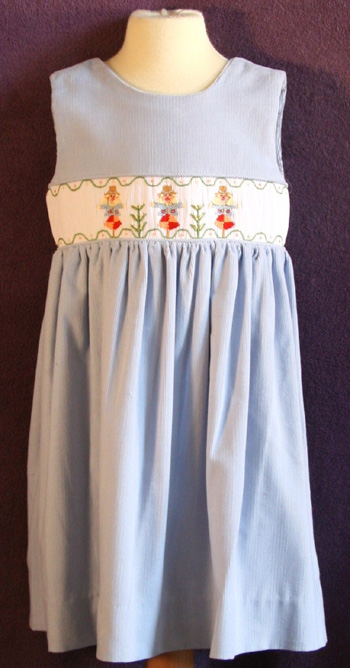
Mothering, I soon discovered, was an endlessly creative job. My artistic self smocked tiny dresses for my daughter, rompers for the boys. I marched clowns and balloons, cupcakes, and teddy bears across their tummies. I looped ribbon into “frou frous” and sewed them onto my daughter’s dresses and hats. I made tiny linen and velvet suits and vests for the boys. I made doll wardrobes and Halloween costumes. (Think my daughter as Pooh and my first son as Piglet when I was pregnant with Number Three.) I made matching velveteen mother-daughter-son outfits for Christmas. And I used a gallon milk jug and fake fur to create a dead wringer for a Coldstream Guards hat. (For my daughter, not the two boys.)

Of course, this activity was not a California Mother Thing at all. California Mothers (the ones without nannies) wore yoga pants and stuffed their children into knit rompers from Mervyns and Gymboree. My activities were so unusual that I had to smuggle a “pleater,” the device consisting of rows of tiny needles that prepares fabric for smocking, back from Tennessee in my suitcase. I ordered smocking patterns and laces and tiny French hand sewing needles from Georgia and Florida and Virginia and Texas.

And naturally I didn’t send my California children to school in these artworks that only a Southern Mother could love. No, as soon as my daughter could pull the OshKoshs off the hangers and put them on, one leg at a time, the dresses hung in the closet quietly waiting for Sunday, like the Good Girls they were.

But, of course, Sunday came. And again, I behaved as a Southern Mother would. CHURCH. Being Episcopalian, we had no duty (Thank, God) to proselytize the California Mothers and their offspring. I could quietly dress my little ones in their smocked and French handsewn best and shuffle us all off to Sunday School (which, true to Southern Mother Form I taught) and CHURCH. (Where I provided stickers and crayons and paper and tiny coloring books to keep the small troops quiet through the boring (to them and sometimes to me, true confessions) service. One interesting Sunday, my small daughter pointed out we were almost the only people there under fifty. Everyone else was at BRUNCH in their yoga pants and knit rompers, California Style.

But I was a Southern Mother. I didn’t know any better.

Being creative as a mother wasn’t just about their clothes. No, it was far deeper and more fun and more substantive than that. Southerners love stories and are born storytellers. I told stories about the South and about their grandfather the FBI agent and their great-great-grandfather the Civil War solider (for the Union!). I read and read and read and read. We loved Thomas the Tank Engine (we called him “Thomas Tanken”), Madeline, Good Night Moon, the Runaway Bunny, Winnie the Pooh, any alphabet book ever written, and all forms of Nursery Rhymes. We watched Sesame Street, talked about “Bee Bo,” “Oscar the Grouch,” “Cookie Monster” and “Count One Count.” (My daughter’s name for him which I thought much better than the original.)

We went to Disney moves, although my daughter wisely decided she did not want to be a Disney princess like her California counterparts, who would ditch their knit rompers for princess gowns, tiaras, and scepters to wear to the park. My daughter, on the other hand, put on her Coldstream Guards costume for outings and marched beside her little brothers’ stroller.

We ate fish sticks and tater tots for supper with plenty of ketchup. We had pillow fights and said prayers at bedtime. (Always the Lord’s Prayer because Now I Lay Me had terrified me as a child because it talked about dying.) We waded in the Pacific on days that never seemed to end because of the stifling heat. (The kids’ dad, who worked in air conditioned comfort, said we didn’t need to be cool.) And we promised every time that we wouldn’t go in the water in our clothes. But we always did. In short, the four of us laughed and created and played and had fun, Southern Mother style, in the foreign country of California. We made few friends, although we tried. But we had each other.

Somewhat skimpy ribbon frou frou on dress

Bee Bo!

Thomas Tanken!

A Smocked dress

Her costume looked like this!


A pleater.


Read Full Post »

The seasons change in Southern California, but subtly. For the first two autumns I spent here, I was always waiting for the cold, wet, windy day that would announce winter had landed. That day always came in the South, a day when it became apparent that winter coats were now inevitable until late March or early April.

But to me autumn in Southern California has always consisted of the uneasy feeling that real winter is just around the corner. Except there is no corner, and real winter never arrives.

In my second autumn-waiting-for-winter here, my September baby began to settle into life. By late January, she slept more and cried less. From her infant seat, she began to look around at the world she found herself in, appraising its potential to entertain.

Less sleep deprived, I started to recover from months of living in survival mode. At last I began to feel separate from the child who had not allowed me to put her down since birth. And as I did, I began to reconnect the dots of the picture that was me. It was as if coming to California had severed my life into two halves. In half number one, I had been first a teacher and then a lawyer, married to a gentle man who wanted me to assume the responsibility of breadwinner. In half number two, I had married a man who ignored me, I had had a child, and I had lost myself. Why had I chosen this path? What had I been running from?

At least part of the answer could be traced to a deep winter day in February in Virginia. One morning I was sitting in my tiny cubicle of an office (it was exactly the same size as a secretary’s cubicle, but it had a door), watching the icy James River slide by my window and wondering if there would be black ice on the commute home. To say I was bored would be an understatement. I had never dreamed life in a big law firm could come to a crashing halt, day after day. But the litigation partner I worked for was busy on matters that didn’t require my help; and likewise the senior associate, who would be a partner within a year, hadn’t produced any interrogatories for me to draft or answer for more than a week.

Enter a Newly Minted Partner in the labor practice, looking for an associate to do a research project. I was “loaned” to the labor section and ushered into a conference room whose floor was white with paper. Every legal job begins with a story. And this was the story.

Newly Minted Partner, who was the rarity of all rarities at The Firm, a Female Newly Minted Partner, had just lost a Motion For Summary Judgment with her Mentor Male Senior Partner (to become partner at that firm, it was an advantage to have one of these). Now Summary Judgment is the worst legal insult possible. It means your lawsuit did not even get to first base. You filed something that didn’t state a claim a court could consider. Bad news. You’ve wasted everyone’s time. And money. And the client doesn’t think you are very smart.

Now The Firm, being one of the smartest and best anywhere, rarely fell victim to Summary Judgment. But, then, again, no one is perfect. Although The Firm did not see things that way.

At any rate, the paper on the floor was nearly every sex discrimination case ever decided by an appellate court. My job was to find the rest of the slippery little dears – if any more existed – and turn them into a memorandum that would be The Firm’s Secret Weapon to be used by Newly Minted Partner and Mentor Male Senior Partner when they went back to show the judge just how wrong he had been to dismiss their Age Discrimination Case. Or, in the alternative, my memo would be the basis for writing a new lawsuit that no one could throw out. Either way, The Firm had been embarrassed in front of one of its Highly Important Clients. And I was now thrown into the breach to repair the damage.

That project seized my imagination as few projects had done since becoming a Big Firm baby lawyer. Maybe it was the sight of a woman who had survived to join the Inner Sanctum that grabbed me. More likely it was just the intellectual challenge of making sense of all that paper. One of my professors in graduate school, when I’d been dreaming of being a professor myself one day, had explained we are biologically driven to create order out of chaos. So perhaps my creative juices were happy to be alive and well again.

I was given two weeks to produce The Firm’s Secret Weapon, otherwise known as my memorandum. I threw myself into it, spending twelve hour days reading and researching, sometimes working while lying flat on my back on the floor because I was in the grip of a nasty inner ear infection that gave me vertigo. (Someday I will tell you how I discovered baby lawyers were not allowed to be sick. But that is a story for another day.)

My then-husband was quite supportive. An extraordinarily bright man, he listened as I talked endlessly about the project and my findings. He made helpful comments here and there even though he was not a lawyer himself. And I’m sure in the back of his mind was his devout hope I would survive to become a Newly MintedPartner one day for our Mutual Economic Benefit.

Trouble was, about three days into the project, I saw why The Firm had lost. The existing law was against what they were trying to do. The judge, whom Newly Minted Partner had not had nice things to say about (use your imagination, but remember to keep it professional), had actually gotten the law quite right. Oh, dear. What was a baby lawyer to do?

Now, despite what happened next to me in this story, the truth is the best lawyers are creative. Think Thurgood Marshall and Brown v. Board of Education. He saw the possibilities in the law where none yet existed and pushed forward to change the lives of every non-white, non-male American forever. (Yes, Virginia, the African American civil rights movement made the Women’s Movement Possible. And now the push for Gay Rights. We owe it all to Thurgood.)

Anyway, I wrote my memo, explaining the existing state of the law and then explaining how Newly Minted Partner and Mentor Male Senior Partner could draft a new pleading, using the Sex Discrimination Law creatively for an Age Discrimination client. If it had been a law school exam, I would have had an A plus plus. I finished, after a nearly all nighter, handed over the thirty page extravaganza, and went home to sleep the sleep of the Righteous. My then husband, Ph.D. in English in hand, had read my magnum opus and congratulated me on my writing and my presentation. Even he, a non-lawyer, got it.

TWO WEEKS LATER:

I know it was the end of February. I like to think maybe it was leap year and the 29th, so it is a day not often to be repeated. But I am not sure. I was summoned to the Ninth Floor to the office of Newly Minted Partner where I expected to receive congratulations on my work. For not every one of us spiffy little J.D.’s can see how the law can be pushed and molded and prodded to the next level of social change. And no one had ever said I couldn’t research and write with the best of them. Until that day.

She was one of those enviably thin women whose suit skirts never had to be fastened with a safety pin. (True confessions. All that sitting at a desk and Firm Luncheons had taken its toll on me.) She had the short, professional haircut we all thought was required in the eighties, and she had the most highly polished French manicure I had ever seen. She was certainly a woman in charge of her life and highly successful in a world and time where women did not succeed. She’d sacrificed marriage and children to her success, but I assumed it was a choice she happily made.

I admired her as a sort of Legal Rock Star. And I had put my everything into her work. And she spent the next forty-five minutes telling me what a Worthless piece of Human Trash I was. About three minutes into the diatribe, delivered in the low professional tones you would associate with someone of her standing, I realized that she hated me, my work, and the creative solution I’d given her. Rather than seeing the beauty of my striving, she pronounced me an ignoramus for not coming to her on Day Three of the project and telling her the law was not on their side. (Something I had assumed was obvious from the beginning since they were the victims of Summary Judgment.)

Newly Minted Partner wore hats. Even now, it is rare to see a professional woman in a hat. Especially a red hat. As the diatribe continued, I fixed my eyes on the stryofoam head behind her desk that held her hat and pictured my head there in the morning, eyes glassy in what she would have considered my well-deserved death. The whole idea was so ludicrous, I wanted to laugh out loud. But I’m sure Newly Minted Partner would not have taken it well.

Her parting shot, as she released me from the hell of her office, was “We couldn’t bill the client for your work!” The ultimate disgrace for a Big Firm baby lawyer.

I went home and cried all night. My then-husband tried to comfort me, reminding me over and over how unreasonable she had been. But she looked so wise and knowing behind that Big Firm desk under the guise of Big Firm Partnership, I forgot who I was. And I let her bully and humiliate me. And then I eventually fled to the other side of the world, away from everything familiar, cutting a swath through the center of my life, in an effort to escape my own incompetence. Except, I wasn’t incompetent. And I had nothing to escape. But I was a long way from discovering that fact in the first autumn of my daughter’s life.

So, as I began to come back to myself in the mild California January, I blamed myself for being creative – the very thing I was born to be.

Below:  Richmond in Winter.

Read Full Post »

After my first terrifying experience as a “trial lawyer,” in October 1981, I devoutly prayed each night I wouldn’t be sent back to court any time soon to sit behind a counsel table. Of course, if you stop and think about it, sending a one-day old lawyer with no trial experience into the lion’s den of superior court to oppose an injunction was an especially rotten and unreasonable thing to do. I had, after all, taken a job with A BIG FIRM to learn from highly talented and experienced attorneys. Imagine what I would have learned that October afternoon by watching the Firm’s Tallest Partner in action, instead of being fed to the wolves myself.

But even in 1986, hiding out in San Diego, holding my crying infant night and day, a world away from the east coast and that first job, and with the vague feeling I was running away from something I could not name, I was still looking back on those baby lawyer days and blaming myself. Shouldn’t have.

After the year rolled over into 1982, (did I mention they made me and me alone, work on Thanksgiving Day?) my old nemesis Legal Aid reared its head. THE FIRM expected baby lawyers to take on Legal Aid clients pro bono, and I was happy to sign up for mine. I actually thought lawyers could change the world by helping poor people back then. Wrong again.

My client was a twenty-year-old highly attractive African American woman who wanted a divorce. She’d been married a year, no kids, no money. In theory a slam-dunk legal proceeding. Her major drawback was she liked to sit in my office for hours spinning obvious yarns about abuse at the hands of her soon-to-be ex. I wondered if the lawyer-client privilege allowed me to tell her I didn’t believe a word she said.

Legal Aid helpfully sent along THE FORMS that I was supposed to file to ask for her divorce. Now, by this time, I had begun to suspect that law was not about language so much as about filling in blanks. I spent a lot of my time drafting “Interrogatories” which are questions one side in litigation poses to the other to figure out what their evidence is going to be at trial. The art of drafting Interrogatories basically consisted of copying the forms from the book, inserting the correct gendered pronouns, and sending these linguistic wonders to the typing pool. (And yes, we had an overnight typing pool that took over when the secretaries went home.)

But as I worked on the Legal Aid forms, asking for my client’s divorce, I saw better ways to say what needed to be said. I had, after all, a Masters in English and had worked on my Ph.D. I had been a technical editor. I had taught writing. Wouldn’t I be the one to know if there was a better way to say it? Apparently not.

I crafted the divorce documents and had them filed with the court where they would percolate for six months until the State of Virginia decided to free my client of her improvident marriage decision. I never expected to get anything back other than a piece of paper saying my client was a free woman. So imagine my dismay and horror, when after three months, I was personally summoned to the judge’s chambers one afternoon.

His Honor, sans robes, sat at his desk, the court file for my client’s case in front of him. I sat on the other side, in my man-tailored lawyer suit, starched blouse, floppy bow, and one-inch heeled pumps. I could see red marks that looked like blood trails all over the top paper in the file on His Honor’s desk. It was the pleading I had filed.

After ten seconds, I surmised a couple of things. One, His Honor hated me. No clue why. But he did. Two, he hadn’t called me in to thank me for volunteering for Legal Aid.

For the next hour, His Honor spat out a monologue about how THE FORMS were sacrosanct and NOT A WORD COULD BE CHANGED. According to His Honor, the words I had substituted in place of the SACRED TEXT made my pleadings totally inadequate, and my client could not get a divorce. He made it clear he had nothing but contempt for BIG FIRM ASSOCIATES who were trying to be Legal Aid volunteers. In his view, we should stick to representing only BIG BUCK CLIENTS because that was all we were good for. I didn’t have to read His Honor’s bio to figure out he’d never darkened the door of a BIG FIRM before going on the bench.

My punishment was to have my pleadings declared null and void, and I was sentenced to the ignominy of slinking back to my office and drafting new ones, this time inserting only my client’s name, her gender pronoun, and the correct dates into the text. After having these prepared in overnight secretarial, a winged-foot firm messenger deposited these linguistic gems in the courthouse. And my client would now have to wait another six months for singlehood because of my incompetence.  The first three percolating months with the WRONG WORDS didn’t count.

So what had I learned so far about being a lawyer? A couple of things. First, being sent to court to oppose injunctions was like being Daniel cast into the Fiery Furnace. Except no angel came down to get between me and the judge who said my client was lying. Major slip up in heaven that day.

Two, lawyers, whom I had thought practiced law, were actually practioners of black magic, wearing black man-tailored suits instead of wizard robes, but pretty much doing the same thing that wizards do: casting spells for dissolution of marriage using spells set out WORD FOR WORD AND NOT TO BE CHANGED in THE SACRED BOOK OF FORMS. Yep, being a lawyer was not what I’d expected. And creative? Well, law school said lawyers were creative, but so far I wasn’t seeing it.

Next time: My Head on a Pike or THE MEMO WE CAN’T BILL THE CLIENT FOR!!!! 

Read Full Post »

« Newer Posts - Older Posts »