Feeds:
Posts
Comments

Posts Tagged ‘law’

Back in the day when newspapers arrived on the doorstep in the morning instead of on iPads, Nooks, and Kindles, people had careers as newspaper columnists. Anne Landers, who died recently, was one. Erma Bombeck was another. Depending on whether the column was published daily or weekly, the writer labored on a regular basis to produce copy audiences wanted to read.

Now I fully understood that a serious blogger has the same responsibility when I opened my little word shop on WordPress some months ago. I figured the Christmas holidays would be my temptation to backslide. Wrong. I sailed through Christmas with flying blogger colors.

No, it was January that derailed my weekly posts, and work that snuck up on me on little cat feet like the fog in Carl Sandburg’s poem. My job involves three things: reading, writing, and staying sane reading about crime for a living. I am the appellate version of the public defender, and I tell the stories of guilty people who have made some pretty bad mistakes. I tell their stores to the mid-level courts of appeal here in California and to the California Supreme Court and write lots of legal reasons why they should get new trials. (That doesn’t happen, much, as you’ve guessed.) You lose in the trial, court I’m your next step in the food chain.

How do you represent guilty people, most people gasp at this point. It’s not hard. Here’s why: a good lawyer is like a car mechanic. Think about it. Your mechanic does not get emotionally upset when you and the tow truck arrive at his shop. (Well, truth to tell, they do get kind of emotional about MiniCoopers, but that’s another story and an exception to the rule. Every lawyer knows there is an exception to every rule and probably more than one. But that’s another story, too.)

Your friendly car mechanic does not give you a lecture or cite scripture or otherwise have an opinion about fault and broken machinery as your car exits the tow truck. No, the mechanic looks at the problem, gives you an estimate, and goes about the job of fixing what he can.
His blood pressure never rises.

And that’s what I do. I read what happened at the trial and write the story for the court according to a prescribed set of legal rules. I do not judge. That is not my job. The jury judges. I just write.

The other way to look at what I do is to consider baseball. I’m the pitcher. My job is to throw the balls across the plate. The umpire (the court of appeal) calls the balls and strikes and says when the batter is out.

Anyway, although I am paid by the state, I am a subcontractor, which means I am self-employed. I had no background in self-employment until I began this job. My father was a government employee, and I had always had salaried jobs, too. The downside to salaried work is you work according to hours your boss sets, on projects your boss dictates, and according to rules your boss makes. In exchange for giving up these freedoms, you get a paycheck at promised intervals from your boss. But self-employed people only get paychecks when they have completed the work they have contracted to do. Sometimes that means a lot of paychecks, and sometimes it means not so much. Work flow is uneven. The perks are you have more control over your time and the projects you agree to do. You set your own hours and work in you jammies if you want to. (Me the fashion plate does not often want to. But that’s another story, too.)

There are advantages and disadvantages to both forms of employment, and everyone is different; so it is not a one-size-fits-all world. It took me a long time to learn how to manage my little business, but I’ve done a good job, and I’m very proud of my achievement. I’m rainmaker, CEO, chief partner in the firm of one, accountant, secretary, and gopher.

To my great delight, January rolled around with a bumper crop of good projects for me. Smile! But that meant giving up a lot of my own time to read and get ready to write the briefs that will be due over the next few months. Sigh! So I’ve not forgotten my responsibility as a serious blogger. I’ve just had it temporarily derailed by a sudden influx of work. Instead of blogging at night, I’ve been reading about murder. And not murder as in Agatha Cristie or Inspector Morse.

I’ve missed blogging, but self-employed people must never, never look a gift horse in the mouth. It is very bad luck. Always, always be grateful when you have too much work to do. Beating the bushes looking for work is not fun. This is the first and the greatest law of self-employment.

I suppose I could make up for my lapse by posting in rapid-fire succession all the posts that have been on my mind over the last few weeks. But I kind of dislike being bombarded. I respect my fellow bloggers who, like me, have fallow times. Four posts a week from the same source, as entertaining as they can be, sometimes overwhelm me. I want to take in everyone’s info and express my gratitude, but there’s only so much of me to go around.

Anyway, I am back. I intend to adhere to one a week, and I am grateful for the New Year, for my readers, and for all the pages and pages of murder trials that are hanging around my office waiting to be spun one by one into unbrief briefs. (Only a lawyer would call 25,500 words a “brief”!)

iah109ts

Read Full Post »

I have been crying since mid-day on Friday. I came home after brunch with my oldest child, my lovely now grown-up daughter, to hear the horrible news from Newtown, Connecticut. For the rest of the day, I sat at my computer writing an opening brief in another heartbreaking case – a father’s trial for the abuse of his six-week-old baby – and I cried as I worked. It was all I could do.

I kept thinking of Jeremiah 31:15: “Thus saith the LORD; A voice was heard in Ramah, lamentation, and bitter weeping; Rahel weeping for her children refused to be comforted for her children, because they were not.” So I thought of Passover and, then, later of Herod’s massacre as he searched for the Christ child. Matthew 2:18, writing of Herod, parallels Jeremiah: “A voice is heard in Ramah, weeping and great mourning, Rachel weeping for her children and refusing to be comforted, because they are no more.”
There is no grief deeper, I think, than the loss of a child. Jeremiah and Matthew capture that. A born Southerner turns to the King James Bible in times of great grief, even if he or she hasn’t been in a church for some time. It is our heritage and our culture. So the words haunted me.

As I worked and cried, I looked over at the Christmas tree in my living room. News like this never comes at an acceptable time. But it’s particularly hard at Christmas when children of six and seven still believe in Christmas Magic. When my own children were small, I taught Sunday School; and every Christmas, I taught them about the coming of the Christ Child and about the shepherds and the Magi, who traveled to witness the miracle of so much love entering our world. Children of six and seven can believe in the magic of Santa and the joy of Christ’s birth whole-heartedly in a way that we, as adults, can only marvel at. And bask in its glow.

The conundrum of human love is that it inevitably leads to loss. In what form, we cannot predict. But from the beginning of any loving relationship, we know there will be an inevitable end. Some people – and I have known my share of them – refuse to love so they cannot experience loss. To me that choice is the equivalent of refusing to live. For only by loving others can we be truly who we were born to be and be truly alive.

When my grandfather was 104 and still as sharp mentally as anyone could be, he said one day that he was not afraid of death. He said that to him, death was simply another part of life. I have lived from my beginning knowing that we are immortal spirits. I will not tell you how I know. That is too personal. But I know. And so I know that the twenty-six amazing souls from Newtown have been separated from us, but they have only been transformed, not lost. Still, the separation is a great grief. Yet as I watch and experience this profound sadness, I see how this unthinkable loss unites us, and I marvel at the strength and the good that comes from human beings in the face of great tragedy. The word that Emilie Parker’s father used in his moving speech about his lovely child is the touchstone for all of us: Compassion.

I cannot travel to Newtown and place flowers or candles or stuffed animals at the memorial. I cannot tell every parent how I how hold them in my heart, and the tears I have shed with them. But on Saturday, I did finally think of my own private way to create a memorial in to these amazing souls. And it goes like this:

I was buying food at Trader Joe’s. Our TJ’s is also next to a Chuckie Cheese, so on Saturdays the little food store is full of families who have completed the Chuckie Cheese adventure and are buying groceries before heading home. Tiny people are whizzing tiny shopping carts through a highly crowded environment and, at the same time, looking for the Trader Joe’s Monkey, hidden somewhere in the store. Finding the Monkey nets a child a sticker or sometimes a gold coin made of chocolate.

As I began trundling my own adult-sized shopping cart through the store, I dodged several pint-sized shoppers who were bent on finding the Monkey and definitely were not looking where they were going. And suddenly I realized that I was not all inconvenienced by having to look out for them. No, I was inspired by their joy and happiness, and by their confidence they would reap the prize at the end of the adventure. And I thought that if the new little angels from Newtown were powering those shopping carts, they would be excitedly on the same adventure. And I was happy at the thought.

If you let it, the joy and magic of being a child can still rub off on your adult self. My own personal memorial will be always to enjoy and give thanks when I am in the presence of the magic of children. I have to say, I have always believed in this. Kids and dogs come to me spontaneously – I guess because I never grew up. But I don’t say think you enough for being in the presence of so much joy. And from now on, I will. And I will remember Newtown and its children, whenever I do. Thank you for the magic of being a child and for letting those of us who have grown up be touched by your magic. We love you.

Read Full Post »

The National Institute of Neurological Disorders and Stroke says “nearly everyone” at some point experiences lower back pain. What an optimistic thought!

Well, I can say I am now a card-carrying “nearly everyone” because for a few months now, my lower back has been complaining about being Itself. When I ran out of physical therapy sessions, I trotted off to see the Spine Specialist to get some more.

Now, the Spine Specialist was not someone to be taken lightly. Like a college course, he had Prerequisites. After getting over the first hurdle and demonstrating I had insurance and could otherwise afford him, I had to get over the second requirement: get the offending lower back x-rayed. However, that was not a difficult chore. I showed up at the Imaging Center, put on one of those silly hospital gowns that no one can tie in the back, and stood in front of the x-ray machine, having a pleasant chat with the technicians for about ten minutes. Blood pressure barely raised. Mission Accomplished.

A few days later, armed with my lovely pictures in black and white on a DVD in a cute little pink and green paper sleeve, I was ushered into the August Presence of the Spine Specialist, who turned out to be a nice young doc with a lawyer sister and a great sense of humor. He watched me walk back and forth across the office a few times, poked here and there, and said I’d have to get an MRI. I decided it would not be polite to point out that I’d already brought him some perfectly nice x-rays that did, in fact, report my lower back had Issues. He had The Picture, in other words. What more did he want?

Now I had my doubts about that MRI from the get go. A couple of years ago, I took a big, splatty fall in my house and wound up in the emergency room around 10:30 at night where they were trying to decide if I had injured my spleen and, therefore, was going to bleed to death shortly. After the CT scan, which I was not a fan of by the way, they decided my spleen was perfectly all right; but not to be outdone for drama, they then decided I had an unknown something on my liver. At around midnight, they announced I was going back to radiology for an MRI to see if the newly discovered spot was going to kill me any time soon.

And I said, NOT! For a number of very good reasons. First, it was the middle of the night. Second, I’d been there most of the afternoon. Third, I was starving. And, fourth and most important, I wasn’t in the frame of mind to hear I was going to die on an empty stomach in the middle of the night. That news could wait a few days. Or at least until I’d eaten and slept. (In that order.) So I went home, leaving the ER Drama Queens without their fix for the evening.

And then, ever obedient, I showed up a few days later, rested and fed, for the MRI at the Imaging Center. As you’ve probably guessed, it didn’t end well. After about a hour of being stuffed into the tube with a belt around my middle which didn’t let me breathe, I pushed the panic button and got ejected from the contraption, white as the sheet covering me and on the verge of passing out.

The technician panicked and called the radiologist, who brought along the rest of his lunch to finish, in case I wasn’t actually going to pass out or die on them. Both of them stood over me while I gasped for air and tried not to see stars. Ejected from the tube, and with the happy news I had nothing worse than a birthmark on my liver, I headed home. But not before the radiologist, still munching his lunch, leveled a parting shot as I exited: New time, TAKE DRUGS.

Which I hadn’t the slightest intention of doing. I don’t like to be drugged. I’m not addict material.

Anyway, in order to return to the August Presence of the Spine Specialist, I had to report to the Imaging Center once again this last Saturday morning. I was DETERMINED to get through this one , and to prove I was not a wimp. Everyone said MRI’s were nothing, so nothing they would be to me, too.

Besides this one was an OPEN MRI. Which I quickly discovered was about as closed as the other one. It just had a kind of peephole on the left-hand side.

However, still DETERMINED to spend all fifteen minutes in the thing, I put on the headphones which were playing Chopin and let them slowly slide me into the machine. AND THEN —- It sounded as if a jack-hammer was drilling inches from my tummy. Chopin vanished, to be replaced by the worst banging and vibrating I had ever experienced. I closed my eyes and tried to go into Zen mode, wishing for an out-of-body experience that would last all of fifteen minutes.

But, alas, I remained firmly stuck in body and under the jack hammer of the machine. Suddenly I realized that the vibrations were triggering an odd little heart arrhythmia which I’ve had all my life. The doctors assure me it can’t kill me, and so far they’ve been right. But it is very weird to feel your heart actually pause long enough for you to wonder if it’s going to beat again.

While I was urging my happy little heart to make up its mind, I pushed the panic button. I had lasted less than a cowardly three minutes. I had completely and utterly flunked the MRI. Again.

Well, Spine Specialist happily forgave me because I’m such a doer. I stretch and work out my core, and buy new chairs to sit in. And I chant Louise Hay affirmations about moving confidently into my future (although I don’t tell the Spine Specialist that one.) My back is better and I’m determined it is going to GET WELL.

But here is my question for the medical profession. If we can put a man on the moon, find water on Mars, and transplant hearts and faces, how come we can’t make an MRI that lets you have a pleasant chat with the technician the same way you can with an x-ray? I mean get real. Who actually wants to be stuffed into a tiny tube and subjected to all the joy of having a jack hammer go off above you every so many minutes? Who said that is utterly benign activity? Definitely NOT ME! I think the attorney who gave the Bush administration the legal opinion that water boarding was just fine, should have suggested the MRI instead. Those guys would have cracked in a heartbeat. (Especially if they have hearts like mine that sometimes stop to Make Up Their Minds.) And I’m sure the Geneva Convention wouldn’t have batted an eyelash.

The MRI

The MRI

Read Full Post »
I spent the day yesterday as a cock-eyed optimist. The optimist part was deliberate. The cock-eyed part was not.

I wear different contacts in my left and right eyes. My right eye is corrected for distance. My left eye does the heavy lifting up close. Yesterday morning I switched lenses. Oops.

Now, I’ve done this before. The little packages of disposable lens all look the same – particularly when I don’t have my glasses on. If I squint, I can see the 3.50 power that goes in the left eye and deduce that the remaining 1.25 goes in the right. But yesterday, I was rushing to get started on work, and I didn’t bother to squint. So I slapped the wrong lens in the wrong eye. And I didn’t notice my mistake for a quite long time.

Well, that’s not true. I knew at once my eyes felt strange. But I attributed it to dry-eye because I’d spent a long day the day before at the computer writing a brief, but complicated, brief for the California Supreme Court. (Yes, I did just use the world “brief” twice in the same sentence, once as a adjective and once as a verb.) So to counteract my “dry eye,” I grabbed the bottled water and started drinking. Pretty soon, I was counting the birds on the wall paper in the bathroom and wondering why my eyes still felt weird.

It was not until I walked into FedEx to leave my brief to be copied and bound around two p.m. that I realized my distance eye wasn’t working and my near eye wasn’t reading fine print. It felt weird, and the world looked weird, too. All at once too bright and too sharp but oddly fuzzy around the edges.

I was supposed to go to Costco for a major munch through of food samples and to buy household must-haves such as gigantic packages of paper towel and plastic wrap, but I dashed home and relieved my eyes of their cock-eyedness. Whew! Just in time, the world came back into focus when I switched the lenses.

This morning, I was super careful to get the proper lens in the proper eye. But I thought about yesterday. How many times in my life have I rushed to the conclusion I understood something, when in fact, I didn’t have all the information? How many times have I thought a situation was in focus when it wasn’t? Probably not often. I’m pretty cautious when it comes to drawing conclusions because of my professional training. But my eye experience yesterday reminded me that sometimes the universe is telling me to slow down and listen, something needs attention. Next time, I won’t wait all day to rearrange my contacts. And the next time my intuition says listen, I will.

The usual suspects.

The usual suspects.

Read Full Post »

So from my last post, you could pretty well guess the Windows Phone was not going to be a part of my life for very long. On Monday afternoon, after I brought it home on Sunday, I boxed it up and headed for Verizon with my youngest son, Michael in tow. The phone itself was wonderful, but it did not have Google Maps; therefore it did not have Google navigation. We had downloaded the Garmin Navigation app, but it wasn’t knocking our socks off.

Still the Windows Phone gazed at me and Michael from its box and begged for one more chance that Monday afternoon. So we left the Verizon store unvisited that day.

The charms of the Windows Phone were so seductive, Michael went out and got one, too. Now he has interned for IBM and MicroSoft and will be with Google next summer. So I kept telling myself, this Windows Phone has got to work out because Mikey likes it.

For the rest of that week, I gave the Garmin Navigation app a chance. I even turned it on to take me to places I knew how to get to. And I discovered a couple of disconcerting things about it. One, it took the most indirect route it could think of. Two, it loved U-turns. I mean it REALLY loved U-turns.

Michael flew back to school on the Saturday after Thanksgiving. He flew into Pittsburgh and picked up his girlfriend, so they could drive back to Virginia Tech together. On Monday he called to let me know the navigation app hadn’t been reliable on the trip to Blacksburg. I have to say, after just tooling around San Diego with it, I wasn’t surprised.

Well aware our Fourteen Days to Take the Phone Back were rapidly expiring, me and Mikey headed to Verizon stores in California and Virginia to divest ourselves of the Windows Phone. In its place, I got a the 4G version of my old Incredible. Needless to say, I am happy to have the new version of my little Droid sidekick back.

This whole episode has impressed upon me just how dependent I have become on my Goolge Maps Navigation. Back in the old days, I’d print directions off the computer, and then struggle to read them in heavy traffic in unfamiliar places. I once had to kidnap a couple of Michael’s friends to read the directions to LAX because my daughter was returning from Ghana, I had to pick her up, and I could never have read the printed directions and executed them in the traffic that perpetually surrounds LAX. (The boys were highly rewarded for their reading skill, I might add. We stopped at In and Out for the best burgers this side of the Mississippi – and probably on the other side, too. I mean, these burgers ROCK!)

My flirtation with the Windows Phone is now history. I am back to plugging in my little Droid friend and sailing off into parts unknown while I listen to its ridiculous, flat computer voice calling the shots. I take this experience to mean, it is good to try new things; but it is important to know when to go back to the old way if that turns out to be the best way. Life is not just about old and new. It’s an ebb and flow of the tide between the two. And besides, you have to love a phone that belches “DROOOID” at you whenever you get a voice mail!

4G HTC Incredible

P.S. If you like to read, check out my book review blog,at deborahsbookreviews.wordpress.com.

Read Full Post »

I stink at goodbye. I freely admit I have avoided the ceremony of parting as much as possible throughout my life. As I was driving away from dropping my youngest child at the airport curb this morning because he is headed back to college in the east, I wondered if my aversion to “saying goodbye” is a virtue or a vice.

It was labeled a vice once by the kids’ dad when he was trying to win custody of the children years ago. Like a prosecutor accusing a defendant of first degree murder, his attorney shouted in open court, “And Your Honor, do you know that she DOESN’T EVEN SAY GOODBYE?” (His attorney always made “she” sound like some really nasty, dirty word that no nice person should ever be called.)

This flaw was supposed to be some evidence of my bad character – I think. I’m not quite sure because the attorney never got any farther than that. She didn’t accuse me of neglecting my children, or of being a drunk or a drug addict, attributes that I’m pretty sure would have won him custody of the kids. No, the worst she could come up with was I don’t say goodbye, which (fortunately for me) did not turn out to be grounds for declaring me an unfit mother.

But at least once in my life, in a public place, someone labeled my aversion to goodbye as a vice. Is that right?

The word “goodbye” is a short for “God be with ye.” Now, I have no trouble with “God be with ye.” I could toss that off in a heartbeat. It sounds so much friendlier than “good bye.” And, as a good Episcopalian I have heard the priest intone a thousand times, “The Lord be with you” and responded, “And also with you.” I actually think I would rather use this ritual in parting because to me “goodbye” sounds so dead end – so final, so “Get out of my life and stay out” or “Yes! You are leaving and never coming back!” On the other hand, wishing blessings to someone and wishing blessings back seems to express so much more love and caring than just an abrupt “Goodbye!” (Which also makes me think of “Begone!”)

Of course that brings the religious problem into play. For those who don’t believe in traditional religion or even God, using the Anglican liturgy at parting would definitely not be an option. But what if we said, “Blessings to you” and the answer was “And also to you”? As a committee of one, I like that better.

Still, I think my aversion to saying “goodbye” is not really based entirely on the word we intone during the “ceremony of parting,” as one dictionary defined it. Where the people I love are concerned, the separation never feels real. In my mind and heart, we are still together even if we aren’t physically in the same place. “Having to Say Goodbye” feels so drastic to me. And even when I do say “goodbye” I inevitably add, “See you soon.”

As I drove away from the curb this morning, the post-holiday sadness began to settle on my shoulders because Thanksgiving 2012 was now officially a wrap. For a brief second I longed for the old way of airport parting, where we parked the car and headed inside and even sat at the gate with our traveler until the call for boarding. Of course we can’t do it that way anymore. So all airport partings are now a quick hug curbside like mine was this morning.

But then, as I swung my beloved red Mini Cooper into the “Exit to Downtown” lane, I realized that the brief hug at the curb is better for me because we aren’t really apart, no matter the miles in between. And, as with every parting from a loved one, I remind myself not to think about the separation, but to look forward to the next visit. Which, in this case, will be in just three short weeks!!!!!

Ok, I admit it. I stink at goodbyes. But I’m not sure that matters much.

Good Bye

Read Full Post »

CHAPTER ONE
Mid-November, 2010, New York

Conference rooms are all the same. As are airports. On a cold, wet, mid-November afternoon, His Grace, the Eighteenth Duke of Burnham, decided that those who thought running the Burnham Trust was a glamorous job should go from London to Paris to Brussels to New York seeing only conference rooms and airports. He was now trapped in one of the beastly things on the twenty-eighth floor of the Manhattan offices of Craig, Lewis, and Weller, studying the deepening early twilight through the sheets of glass that formed the walls. His mood was as black as the coming night. This was the last leg of his autumn trip to ascertain the status of Trust assets in several countries. And two weeks of nonstop polished mahogany tables, crystal water decanters, dense financial statements delivered by earnest twenty-somethings, and masses of sandwiches on large silver trays had been a mind-numbing combination. He longed to go back to his suite at the Plaza, draw a hot bath, and order a bottle of Balvenie Cask 191.

But a quiet evening in was highly unlikely with Ami Hendria in town. Twenty-eight-year old blonde bombshell actresses were not fans of a low key evening by the fire. Still, he would be the first to admit that one reason he kept Ami around was to avoid having the world find out who Nicholas Carey truly was: a middle-aged homebody, longing for some solitude and a nightcap. On the other hand, the female segment of the populace would have refused to believe his real persona if he had posted it on a billboard in Times Square because, as a widowed duke, every woman he encountered believed he was swinging Prince Charming. And he was anything but that.

Oh, he was bored if his mind wandered to scotch and the possibility of eluding Ami’s grasp that evening. To bring himself back to the present, he looked down the nine-foot glossy mahogany conference table and counted the populace. Three lawyers from Beville, Platt, and Fisher on one side, all local counsel for the Burnham Trust. And two on the other side from Craig, Lewis, and Weller for Miss Reilly’s Female Finishing Academy. Why did it take five lawyers to sell a house to a girl’s school? And why weren’t any of them the one he wanted to see? His operative had named Taylor Collins, a partner in the Craig, Lewis real estate section, as was the one likely to know where Diana’s tape was. He’d told Hollis Craig he wouldn’t sell the Abbey to his daughter Tracy’s school unless Taylor was on the deal. Yet, he’d been trapped in this conference room for more than an hour, with no sign of her.

The tape was so sensitive, Nicholas knew he couldn’t approach Taylor Collins directly about it. But he was more than happy to offer Burnham Abbey, the ancestral home of the Careys, on the sacrificial altar of subterfuge. The place had long been an albatross around his neck that he was determined to remove. He smiled happily at his picture of his father, the Seventeenth Duke, turning in his grave in the chapel about now as the lawyers blathered on blissfully and incomprehensibly about the terms of the deal.

For as many of his forty-nine years as he could remember, he had detested lawyers of every ilk. The American big firm types were particularly irksome because they all looked, sounded, and dressed exactly alike. Dark suits, starched white shirts with monograms on the cuff, and subdued silk ties. And the women lawyers. Oh, he didn’t even want to think about their sexless, baggy black outfits. Was being neutered worth all that money they reportedly made? He knew Taylor was thirty-nine, but he bet she looked at least forty-five and was twenty pounds overweight. And probably chain smoked and had a face like a bulldog. He didn’t look forward to dealing with her.

Well, here was his chance to find out. The massive, dark mahogany door to the conference room opened, and another female suit stepped inside. Except this one was so, so different from the others. And not at all the woman he had expected to see.

“Sorry to be late. I had a call from the Cuniff trustee that I had to take.” She was speaking to Hollis Craig, but a pair of eyes the color of spring violets were fixed on him. Very like Diana’s eyes, but deeper.

“My partner, Taylor Collins, Your Grace. She’s going to be in charge of the file for Miss Reilly’s as we agreed.”

His heart was racing so fast, he had difficulty speaking, so he merely nodded in response. At thirty-nine, she looked ten years younger. He guessed the form-hugging black wool suit on her tiny five foot two frame was Chanel. She barely weighed a hundred pounds. Her jacket allowed a demure ruffle to spill over its dark edge, highlighting the single strand of perfect pearls circling her creamy throat. Her dark hair was pulled back into the usual professional woman’s knot, revealing more perfect pearl drops in her exquisite little ears. He wondered what she looked like when her hair was wild and free. Her face was impassively professional, yet he sensed much more lay beneath the surface. Physically he was drawn to her so strongly that he wondered what color La Perla’s she was wearing, but he longed for more than sex. He desperately craved the impossible: time alone and the chance to know who she was beneath the lawyer facade.

The conference room doors opened once more and another black-suited woman with hair also tightly wound roused Nicholas from his fantasies. She wasn’t as expensively dressed, and he recognized her immediately as the telephone receptionist who sat at the throne-like desk opposite the elevators. Her task was to greet everyone who arrived at the twenty-eighth floor.

“Your Grace?”

Why did all professional woman have to slick their hair into those ridiculous knots? Did it make them seem more serious? More competent?

“Your Grace, ” she repeated. She was young, early twenties. There was that look in her eyes that said, maybe I will be his Cinderella. Even a woman in a business suit longs to be a princess. Or at least a duchess. Although he doubted Taylor Collins would be interested.

“Yes, Miss –?”

” La Breaux. Marie La Breaux.”

“Well, yes, Miss La Breaux? What is it?”

“A call for you.”

” I’ll take it later. After we’ve wrapped up in here.”

“I’m afraid it’s the headmistress from your ward’s school.”

“Oh, God. Very well.” Nicholas got up and went into the adjoining conference room, this one dominated by a long glass table, sterile enough for surgery, surrounded by empty high-backed chairs. It looked like a board meeting of ghosts, and for a moment Nicholas saw the empty room as a metaphor for his own life. The people he had loved the most were all ghosts: his mother, Deborah, Diana, Annabel.

“Hello?”

“Helen Myrtin, Your Grace, from Miss Whitcomb’s School.” Her thin, nasal vowels sliced through the silence and reminded Nicholas that in person she appeared as intimidating as she sounded. Thirty-five. Always dressed in suits so crisp they looked like military uniforms. “I’m afraid there’s been a bit of difficulty with Lucy. Again.”

Nicholas had hoped she wouldn’t refer to the past, but in fairness, she had a right to sound exasperated. It had taken a hefty chunk of Trust cash, tastefully donated to the school’s general fund, to keep Lucy there the last time. “Tell me about the problem, Mrs. Myrtin.”

A very human sigh surprised him. “I’m so sorry, Your Grace. I hate giving bad news.”

“If she’s drinking again–”

“I wish that were the only problem. Unfortunately, Lucy has begun to experiment with drugs. She had too much to drink, threw up in the loo, and passed out. One of the other girls found her and called Matron who called Dr. Briggs. When he looked her over he found signs of cocaine use. And later we located some of the drug among her things.”

Nicholas gripped the phone and willed her to stop speaking. The alcohol had started last year. It had been tough to deal with a fifteen-year-old with a taste for scotch. Maybe he should have seen the other coming. But he had put his head in the sand. “Are you very sure that she was actually using the stuff–not just trying to sell it?” Both were bad, but using was worse. It would be much harder to stop that.

“Perfectly sure.” The headmistress’ voice tightened in response to his denial. Give me any window, any hole to escape this he prayed. Don’t make me deal with another failure where Lucy is concerned. I know it’s my fault. But it hurts too much. Far too much. Still, fate had already done its work. There was no going back. “Dr. Briggs says the drug caused bleeding around her nose. The girl who found her in the loo thought she was dying.”

“I see. And where is Lucy now?”

“In the infirmary. We have to send her down. At least until the New Year. You realize that, of course.”

“Of course.” But she wasn’t saying out for good. There was still hope. “But after Christmas?”

“You’ll have to show us that she was treated. And that she’s–uh, how do they say- clean. Perhaps one of those drug management programs in Harley Street. Although I will warn you the source is her boyfriend. He’ll find her if she’s in London. He’s very persistent.”

“Boyfriend?”

“Well, man-friend, actually. Didn’t you know about David Lowenby? She said you approved.”

“David Lowenby is Lord Gaynor’s heir and twenty-five years old. He’s almost ten years older than Lucy. She couldn’t have been seeing him.”

“I’m afraid she has. She told us she had your permission,” Ms. Myrtin repeated.

“And you believed that?” Nicholas didn’t even attempt to control his outrage.

“Well,” her tone of detached poise seemed to slip momentarily, “I did think of ringing you up. But she was so emphatic. Good family. All that.”

He sighed. “Well, the harm’s done. But if I put her in Harley Street, Lowenby will find her with more cocaine. You are right. I’ll have to think about what to do.”

“There are home programs, I think. Nurses you can hire. Maybe one of the Harley Street clinics can give you some information. But we do have to send her away today. And you appear to be out of the country.”

“New York is not the ends of the earth, Mrs. Myrtin. I can telephone my staff. I’ll send an estate car for her as soon as you ring off. I would imagine my driver can be there within the hour.”

“That would be greatly appreciated, Your Grace.”

After Nicholas hung up, he sat for a long minute watching the New York sky line; he felt empty and sad and defeated. She had promised no more drinking. She would study to get into Oxford. She would find some meaning and purpose for her life. Not just parties and shopping. But all her promises had meant nothing. He glanced at his watch: 4:30 here, so 9:30 in London. He could have Lucy at Burnham Square before midnight.

He picked up the phone once more, this time punching the intercom button.

“Marie La Breaux, here, Your Grace.” She sounded so eager. For what, he wondered.

“Please get my butler on the phone and tell him to send a car to fetch my ward from school. At once.”

“Yes, Your Grace. I’m sorry the news was bad.”

But he wasn’t inclined to tell her anything, so he ignored her condolences. First rule of survival in the tabloid fishbowl of aristocratic life. Never give anyone information about yourself. “And get my London solicitor on the line. Lord Thomas. My personal assistant will give you the numbers.”

“Yes, Your Grace.” She sounded more distant now. She had understood he was not going to let his guard down with her.

Kerry Thomas, his chief friend from Eaton, would know what to do. Restraining orders–whatever it took to keep the press out of Lucy’s screw-up. Maybe he could recommend a treatment program. A scholarship boy from a poor London family, Kerry was resourceful. And now rich.

As he sat waiting for Kerry’s call, he wondered if he should fly back to London that night or follow his original plan to return in the morning. His pilot was used to turning around on a dime if Nicholas demanded it, but sticking to his original itinerary looked very attractive. He didn’t feel ready to face Lucy and her problems any sooner than tomorrow night. If then. He could stay at the Ritz for a couple of days and avoid his townhouse at Burnham Square for at least forty-eight hours. Cowardly, but tempting.

Then, too, it was Ami’s last night in New York before she flew to Paris to begin a new movie. She expected him to take her to dinner at Per Se, with dancing afterwards at Provacateur. The thought of all that throbbing music punctuated by green strobes gave him a headache in advance. In addition to being very egocentric, American twenty-something actresses loved night life. And were completely convinced that dukes did, too, despite his sincere explanations to the contrary.

Well, even if blonde American actresses had dukes pegged correctly, and they all liked to boogie until dawn, he didn’t. Maybe it was because he had never felt much like a duke to begin with. Maybe it was because he hadn’t been intended to be one, either. Arthur had been real duke material. He could picture his older half-brother at Provacateur until the wee hours. He didn’t deserve a lifetime subbing for Arthur.

Hours under strobe lights, sandwiched between gyrating, sweating bodies was just the sort of thing Deborah would have loved and would have insisted that he do with her. But even the most boring things had been worth doing – just to be close to her. All at once, he could see another pair of blue eyes. Not deep violet like Taylor’s, but pale as spring rain, cool, and appraising. Deborah’s eyes. Deborah’s voice. “I can’t live locked away in that decaying old house in Kent. Don’t be ridiculous. There’s everything to do in London and nothing at the Abbey except watching it crumble to bits stone by stone. You can’t seriously be thinking of living there.” He could hear her voice as clearly as if more than a decade had not gone by since the last time she had spoken. And he could picture her graceful body and the way she would shake her golden, shoulder-length hair to make a point.

The memory was too sharp and too clear, and it hurt too much. He brought himself back to the dilemma of Lucy. He would leave New York in the morning as planned. But he’d lie to Ami and cancel the evening. She’d be furious, but she’d get over it. And if she didn’t, there were a zillion more just like her waiting to attach themselves to him. He badly wanted his evening alone at the Plaza with his bottle of scotch. No, that wasn’t what he wanted at all. He wanted to take Taylor Collins to dinner at Per Se, drown in her violet eyes, and learn everything about her, including which places on her tiny exquisite body she liked to be touched. But that was out of the question. He hadn’t expected her to be beautiful and sexy, but he had to force himself to stay on track. He had made a promise to Deborah and to Diana. He couldn’t be so distracted that he gave up his quest for the truth.

He would telephone Steve Riddely now and arrange for him to come round early in the morning to look at Lucy and advise him about treatment programs when he returned. Steve’s father had been his own father’s doctor, and he knew he could trust him not to tell anyone why Lucy had been sent down.
As for himself, he was a coward. Tomorrow or even the next day would be time enough to deal with Lucy.

* * *

The next morning, his Lear Jet was scheduled to depart at 8:30 a.m. As he sat on the tarmac, waiting in the queue of airplanes for clearance to taxi and takeoff, Nicholas Carey reflected upon his success the prior evening. Ami had been easily put off with a promise to fly her to London the following week. Apparently she was willing to risk the ire of her director to be with him. Not a good development. But the bottle of Balvenie Cask 191 had been superb. He had almost obliterated the shock of meeting Taylor Collins with its joys.

But he was sober now, and she was very much on his mind. He had to find a way to see her again. Not only to find Diana’s tape, but to learn more about her. How to do it without being obvious? Ah, the sale of the house. She was the lead lawyer on the file for the buyer. This would be easy. Way too easy. He picked up his cell and dialed his personal assistant.

“Myles?”

“Your Grace.”

“I want you to call Suzanne Kelly, the woman at Miss Reilly’s who is overseeing their purchase of the Abbey. Tell her there may be a problem with conveying a clear title to the school; and their attorney, Taylor Collins, must come to England and personally examine the documents to determine whether the Trust can actually sell the house.”

“Will do, Your Grace.”

“And another thing. The land conveyance records are at the Abbey library in the family papers section. Keep them in the library but hide them where they’ll be very difficult to find.”

“Yes, Your Grace. Anything else?”

“Only one. Book a suite for me at the Ritz for the next three days. I need some time and space away from Lucy while I think about what to do with her.”

“Done, Your Grace.”

The jet gathered speed for take off. Nicholas watched New York begin to drop away behind him. If Taylor knew about Diana’s tape, her life was in danger.

Read Full Post »

The “it girls” all arrived as princesses this Halloween. They made the trick or treat scene at our front door in ankle-length pastel blue and pink satin skirts, frothed with sheer tulle ruffles at the waist and hem. Bodices sported sequins and glitter. I doubt there was a Versace, Chanel, or Marc Jacobs in the lot, but each one was thrilled with her red carpet look for the evening. (It was Halloween. I should say orange carpet.)

Observing them as I handed out Halloween candy reminded me that I had had a secret desire to be a princess when I was their age. Just as small boys announced their intent to be firemen or policemen, small girls are prone to favor the princess line of work. The only trouble was, I couldn’t quite figure out what princesses did. Sitting on a throne all day waiting for a prince to show up sounded like the height of boredom. So did swirling around a ballroom at all hours in an evening dress and diamonds. And I wasn’t particularly thrilled about eating a poisoned apple or pricking my finger and sleeping for a hundred years. Just regular sleeping overnight was pretty boring, in my view. So even though I was taken with the princess uniform – evening dress, glass slipper, and tiara – the job that went with it didn’t sound as attractive as I’d first thought.

Then I went to school and began to read history. The princess gig began to look less and less attractive. For example, Henry VIII had no trouble dispatching unwanted princesses to nunneries and scaffolds. A little later, in France, the guillotine did the job of eliminating the surplus princess population. Moving into modern times, a Russian firing squad did away with a whole family of princesses in Ekaterinburg in July 1918, along with an Emperor, an Empress, and a Tsarevich. And then, to prove it still isn’t safe to be a princess, Diana, Princess of Wales was smashed up in a car “accident” in 1997.

Conclusion: “pretend princessing” has its upside: a swirly satin skirt for the evening and all the chocolate you can stuff into a plastic pumpkin on Halloween. But the real thing isn’t safe. You don’t want to wind up as another princess statistic. Just say NO to Prince Charming when he hacks through the hedge after a hundred years.

Regulation Princess Gear

Read Full Post »

PROLOGUE

Mid-April 2010, Paris

In the gray spring rain, he stood in the Place d’Alma staring down at the tunnel where she had vanished from his life on the last night of August 1997. He came here whenever he was in Paris. He counted the pillars until he reached number thirteen, the one that had taken her life. Tears formed behind his eyes, as they always did in this place. But he refused to let them overflow. Instead, he took a long breath of fresh rain mixed with the exhaust of cars speeding through the tunnel.

When the big black Mercedes had entered its skid that horrible night, his last living link to Deborah had been taken from him. Diana and Deborah, West Heath girls, friends forever. Deborah had been dead since 1994, but he had lost her long before she had become his wife just two years after Diana had married the Prince of Wales in 1981. How many nights had he spent talking to Diana about his marriage, about her marriage, about his guilt over Deborah, and about the impossibility of being in love? Too many to count. He ached to tell her now how empty his life had become without either of them.

He stared down the long, gray tunnel, wondering as always, what she had felt as she had slipped away from everyone who loved her. Had she struggled against it, as Deborah had? Or had her torn and broken heart quietly accepted its fate? No, he doubted that. She’d have fought to stay with her boys. Diana hadn’t gone into death quietly. That January, she’d had a warning of what was coming. She’d recorded a video tape naming her assassins and had given it to someone in America for safekeeping. But she would never tell him who it was. Too dangerous, she always insisted. If you had it, they’d come after you, too. Leave it alone, Nicholas. The tape is safer out of England.

His phone abruptly interrupted with a text message from his assistant. He was late for a meeting of the Burnham Trust at the Trust’s Paris headquarters, and everyone was waiting. Well, they could wait. All day and all night if he wanted. He was the Eighteenth Duke of Burnham and the second richest man in England after the Duke of Westminster, and he’d be late if he decided to be. He hadn’t wanted to be a duke, but having been forced into the job, he was going to enjoy every possible perk.

As soon as the news of Diana’s death had reached him, he’d vowed to find her tape and make it public. No luck for the last thirteen years, but his latest operative had just come up with a stellar lead at last. It was so stellar that not only was he pretty sure he was going to find the tape, he was also going to have the opportunity to unload the decaying family seat in Kent and exact his well-deserved revenge upon his father, the Seventeenth Duke.

Hever Castle as the Model for fictional Burnham Abbey

Tunnel, Place d”Alma, Paris

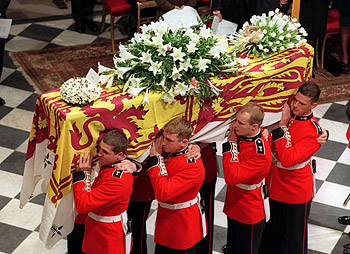
Diana’s Funeral

West Heath School for Girls

Read Full Post »

Life as a stay-at-home mother of three children, five and under, was an endlessly demanding job. I had always been a hard worker and an over achiever, but child/care 24/7 was the most exhausting challenge yet. There were days when, as much as I loved my three little ones, I wasn’t sure how I was going to get up at sun rise and keep going. I had never been so tired in my life. And I had a sinus infection that lasted for three and a half years. One unhelpful and terrifying male doc said I needed to be tested for HIV. The woman doc whom I went to for testing and whose children were the same ages as mine couldn’t stop laughing when I told her why I was there. Honestly, it wasn’t very funny.

I became fascinated with Princess Diana in that period. I’m not sure why. There were probably a lot of reasons for my fixation. First, I loved her clothes. Whether in her early Laura Ashley mode or in her shoulder-padded Power Suit mode in the 1980’s, she was gorgeous. She was the IT Girl of Style.

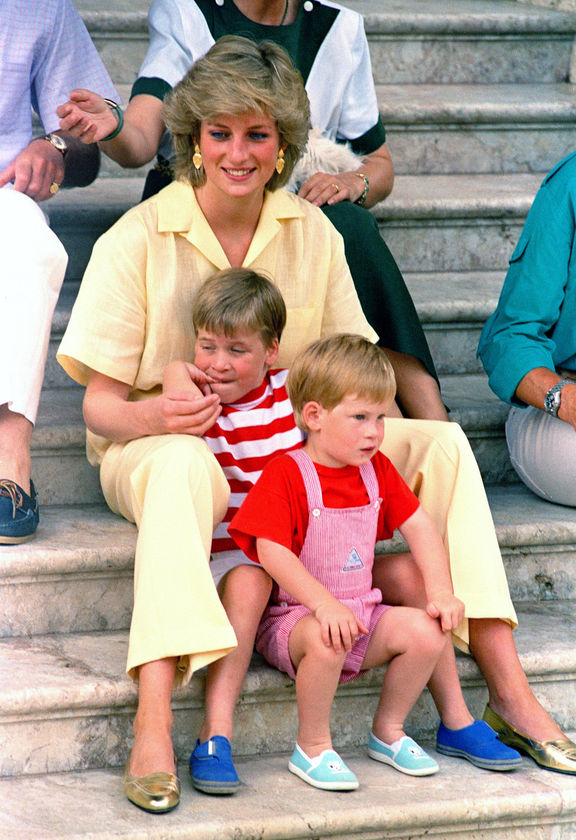
Second, she delighted in mothering just the way that I did. In the pictures of her with William and Harry, who were only a few years older than my children, her love shines off the page. Granted when she played games with them in their nursery, she’d had a full night’s sleep because her nanny was on call, but even my sleep-deprived brain could connect with another mother who loved her children the way I loved mine.

Third, she and I had entered into similar marriages. My husband’s job was to our marriage what Camilla Parker Bowles was to Diana’s. The third party to my marriage was a corporation whereas for Diana it was the Other Woman; but the result was the same. And Diana had married a man who wanted a wife and children from Central Casting to be available only for photo ops. And so had I.

Fourth, Diana went through a very public divorce with a man determined to wound and humiliate. One of my few consolations on those terrifying days when I left the Family Law Courthouse threatened with the loss of my children and so emotionally upset that I was afraid to drive, was that at least the venom that had just been spit in my face wasn’t going to be heard around the world. For Diana, it was a very different story.

I didn’t lose my children. I would have if I hadn’t been a lawyer. Oddly enough, the role that sat most uncomfortably on my heart was the one that saved the people I loved most from being lost to me. But that victory came at a heavy price. During that marriage, I had done the thing I had wanted to do all my life: I had written a novel. After a lot of tries, I even got an agent in New York. In those early dark days of my divorce, my little book traveled from editor to editor at major publishing houses. Some did not like it. Some liked it but would not buy it. It was called Summers’ Child, a title that another writer would use for her own very successful novel some years later. (I had copyrighted my manuscript, and I knew she hadn’t done her homework before using my title.)

But when my husband found out that I had written a novel that was not succeeding with New York publishers, he dragged me down to the Family Law Courthouse and accused me in public of being a no-account deadbeat who was trying to live off child and temporary spousal support. He argued that I was trained as a lawyer, and so I had to go back to work as a lawyer. Even though I hadn’t done any work as a lawyer for eight years and hadn’t the foggiest idea, anymore, how to even sigh on to a legal research service.

Family Law Court, at least in those days, was a terrifying hell of illegality. I had graduated second in my class from law school, and I knew how unconstitutional the various rulings from that court were. The family law court operated at that time as if the Right to Privacy did not exist. At one point, I actually thought they were going to send me to involuntary psycho therapy to force me to withdraw my accurate and true statements that my husband had abused me and the children. I felt as if I’d wound up in a Russian Gulag as a political prisoner for not Speaking the Party Line.

I knew how to challenge these outrageous family law court rulings in higher courts. But the problem was I had to play the Family Law Court game or lose those dearest to me. It would do me no good to take my case to the United States Supreme Court only to be reunited with my children by my victory there when they were adults. So even though the Thirteenth Amendment abolished involuntary servitude, the state of California said I had to go back to work as a lawyer. And I did. In my living room, where I wrote appellate briefs and remained close to my children. But who I really was born to be was quietly dying, day by day.

Read Full Post »

« Newer Posts - Older Posts »